"Count what is countable. Measure what is measureable. What is not measureable, make measureable." -- Galileo

Tuesday, February 17, 2026

The Great Backyard Plone Count Redux

Back in 2015 when I last wrote an entry in this blog, Plone 5 had just rolled out.  Retired from Sandia National Laboratories, I wound down my IT work and dusted off my old ecology degrees.  I started volunteering at our local BioPark Botanic Garden.  I thought I had escaped, but the lure of legacy software systems pulled me back into part-time consulting.  

This past weekend our venerable Plone 5 server with its bespoke Multi-Conference System was finally retired.  It's been replace by an up-to-date Plone 6 virtual server that provides EasyForm delivery.  With that (plus it's a raw, windy day outside), I'm inspired to take a look at how Plone in general is holding up.  

First off, Plone is doing better than cmsmatrix.org, my standby for CMS comparison.  They've gone by the wayside.  For 7 years I had turned to CMS Matrix for statistics, especially on the weekend of the Great Backyard Bird Count.  I would take inspiration from Cornell Labs yearly bird count to make an annual census of Plone sites.  

Now, after an 11-year pause, I'm looking at the stats again.  Fortunately, other more modern tools have popped up to replace CMS Matrix.  Builtwith immediately jumps to the forefront with informative graphics and easy to understand tabular summaries.  


The above graph shows the past 22 years of Plone usage as they have determined it.  The top line comes in at 7271 sites as of January 31st of this year.  This is lower than the golden age of Plone, 2012-2019, but still respectful.  Also, last year's release of Plone 6 definitely reversed a slow downward trend.  

I'm looking forward to how this continues into 2026.  With anti-US feelings becoming manifest across much of the world, there's talk of divesting IT systems of US-centric products and moving to open source solutions.  I sense an opportunity to plug those holes with Plone.  


Friday, January 1, 2016

Plone Metrics' 2015 Person of the Year

This year the clear winner in meaningful Plone stats for 2015 is Plone 5.0.  Here's the graph of session visits to Plone.org for the first 30 weeks of 2015:
There's a slow but steady downward trend that comes along with being a stable, mature release of a mainstream product.  There are minor peaks in late February and for the 4.3.5 and 4.3.6 releases in May-June. 

Now here's the graph of session visits since the release of Plone 5.0 in weeks after 30: 
Week 38 corresponds to Sept. 29, the release date of Plone 5.0.  Needless-to-say, there was over a 20% uptick in visitation to the site, no doubt as people checked out the new release and upgraded their 4.3 sites.  Most notable has been the fact that the trendline is flat, meaning that there is a steady, healthy interest in Plone that has continued for months after the initial excitement of the 5.0 release itself. 

Now on to the main event.  Here are the past winners.

2007 Alexander Limi
2008 Joel Burton
2009 Nate Aune
2010 Eric Steele
2011 Toby Roberts
2012 Martijn Pieters
2013 Elizabeth Leddy
2014 The Year 2020
2015 ?

With this table comes the usual disclaimer:  Plone Metrics Person of the Year is in no way officially affiliated with Plone or its Foundation, but represents my personal effort to thank the whole community.  Of course, there are many, many contributors that are well-deserving of a tip o' the hat:
  • The core developers and release managers definitely need a huge round of applause for all the essential work they do.  Considering how successful Plone 5 has been, Eric Steele probably would be Person of the Year except for my informal "can't win it twice" rule. 
  • The 2015 Plone Conference team and sponsors for Bucharest. Also, a hat tip goes out to all the other event teams and participants.  You are the beating pulse of the community. 
  • All of those who have blogged, chatted on the support channels, and microblogged about Plone are another group of supporters who contribute simply by continuing to communicate your ideas, thoughts, and solutions along with the occasional pieces of humor.  
  • As always, the Foundation Board and the gets a great big nod of appreciation here. 
Along those lines I should point out that Plone still ranks highly at CMS Matrix.  Plone remains in the top 10 whether sorting the huge CMS Matrix list by clicks, views or compares. We've only slipped one rank in views since last year. 
Clicks 10th
Views 8th
Compares 7th
But back to the question at hand, who is Plone Metrics' Person of the Year?  With so many awesome contributors, this has been a tricky one, but I'm going with that long-time herder of cats, Paul Roeland.  With some many things going on in so many directions for Plone, with subgroups and special interests constantly making demands of his time, and as a Board member since 2011 not to mention 4-term President, it seems appropriate to name Paul the Plone Metrics' Person of the Year.  


Thursday, February 12, 2015

The 7th Annual Great Backyard Plone Count

It's that time of year... the Great Backyard Bird Count, organized by the Audubon Society, the Cornell Institute of Ornithology, and Bird Studies Canada.  And that means that it's also time for the Great Backyard Plone Count, this weekend Friday through Monday.

Because many Plone sites are intranets behind firewalls, they can't be located by crawling the web.  This is a chance for developers, site owners, and users to stand up and be counted.  It's a non-scientific, totally voluntary effort for self-reporting Plone-based web portals.  If your input from February 2013-14 is still current, you're already done. 

That said, the input form on the Google Docs spreadsheet is open.  Anyone can submit sightings of Plone in the wild.  The form will stay open until midnight Monday 16 February.  If you have bulk data and the form is awkard to use, kindly contact me and we'll do some behind-the-scenes sharing or cutting-and-pasting.  I'll be doing some mining of Delicious and other social bookmarking services this month and posting them as well. 

Although there's significant bias in a survey like this, the real value comes from tracking trends over time.  This is the seventh annual Backyard Plone Count (since 2009) and as the number of yearly data points increase, we'll better be able to extrapolate from the observations.  It's not that we're getting an absolute count of Plone market penetrations (just like the GBBC isn't counting individual birds), it's just that we're getting a repeatable sampling by the community.  It is as much a measure of community involvement as it is a metric of the actual number of Plone sites out there.

So get out there and spot some Plone sites -- and while you're at it, spend a little time counting birds at your feeder.

Thanks in advance!

Wednesday, December 31, 2014

The Plone Metrics' Number of the Year

Remember last year:  "Therefore, be it resolved that I shall post to Plone Metrics at least monthly in 2014."  Not exactly an epic failure, but only 50% success.  I hereby grant myself resolution absolution.  (Thanks for the concept, Over the Hedge.)  At least I've turned the corner on frequency of Plone Metrics blog posting. 

Thursday, December 25, 2014

'Tis the Season

Yes, it's that time of the year when everyone has misplaced apostrophes everywhere -- T'is the Season.  Just remember, "Axial tilt is the reason for the season," at least when you're an astronomer's son.  

Not only is it ChrisKwanFestNukkStice, it's just a week away from New Year's Eve.  That can mean only one thing:  Plone Metrics Person of the Year and chasing away the wolf that ate the sun (thx to @LeVostrCG).  I'm now accepting suggestions for a metric that can be used to differentiate one member of the Plone community from all the rest of this amazing group of people who keep the wheels of Plone spinning.

By way of a recap, here's past years' winners. 

2007 Alexander Limi
2008 Joel Burton
2009 Nate Aune
2010 Eric Steele
2011 Toby Roberts
2012 Martijn Pieters
2013 Elizabeth Leddy

Whether I've used personal experience, quality of contribution, OhLol measures, or something else, it's always been a difficult decision.  Too many good people doing great things.  If you have an idea for this year's metric, pop me a line @schlepp on Twitter.

Cheers!

Tuesday, July 8, 2014

Programming Languages and CMSs

Courtesy  of a link on LifeHacker, I discovered an interactive IEEE webpage that lets you slice and dice programming languages in a variety of ways.  You can sort them by ranking criteria like "trending," "jobs," "open," or customize your own ranking systems.  Additionally, you can filter them by web, mobile, enterprise or embedded language types. 

Interestingly, Python holds its number 4 spot overall and for all individual language types.  PHP follows in the number 6 slot.  PERL struggles along at 8 or lower, depending on how you select the filter settings. 

That said, it looks like Python is very much a contender in the programming language debate.  I used to teach Python to my class in algorithms because the class text, Corman and Leiserson, Rivest, and Stein's "Introduction to Algorithms," uses Python-ish pseudocode.  In fact, we'd often cut and paste their pseudocode, make a few edits, and run the algorithms with time tracking functions.  Racing algorithms--how to make O-notation fun. 

That, of course, brings us back to CMS.  A search on CMS Matrix for Python-based systems returns 23 results:
  • autowebcms
  • BlackMonk CMS
  • CubicWeb
  • Cyn.in
  • django-cms
  • DXM Multilingual
  • Easy Publisher
  • eContent 3.5
  • Ellington
  • EZRO
  • Macromedia Contribute
  • Mezzanine
  • Nuxeo CPS
  • Plone
  • PublishXML
  • PyLucid
  • Silva
  • Solgema
  • SR2
  • Web Cube
  • WEB123 CMS
  • WebEngine v6
  • zwook
A search for PHP-based systems returns 585.  (Contact the author if you'd like to see the entire listing.)

That's a fascinating mismatch between the IEEE ranking of the programming language and number of CMSs based on the underlying language.  Considering that Plone and Django are the heavy hitters among the Python-based CMSs, this puts them in a positive light. 


Thursday, February 13, 2014

The 6ht Annual Great Backyard Plone Count

It's that time of year... the Great Backyard Bird Count, organized by the Audubon Society, the Cornell Institute of Ornithology, and Bird Studies Canada.  And that means that it's also time for the Great Backyard Plone Count, this weekend Friday through Monday.

Because many Plone sites are intranets behind firewalls, they can't be located by crawling the web.  This is a chance for developers, site owners, and users to stand up and be counted.  It's a non-scientific, totally voluntary effort for self-reporting Plone-based web portals.  If your input from February 2013 is still current, you're already done. 

That said, the input form on the Google Docs spreadsheet is open.  Anyone can submit sightings of Plone in the wild.  The form will stay open until midnight Monday 17 February.  I'll be doing some mining of Delicious and other social bookmarking services this month and posting them as well. 

Although there's significant bias in a survey like this, the real value comes from tracking trends over time.  This is the sixth annual Backyard Plone Count (since 2009) and as the number of yearly data points increase, we'll better be able to extrapolate from the observations.  It's not that we're getting an absolute count of Plone market penetrations (just like the GBBC isn't counting individual birds), it's just that we're getting a repeatable sampling by the community.  It is as much a measure of community involvement as it is a metric of the actual number of Plone sites out there.

So get out there and spot some Plone sites -- and while you're at it, spend a little time counting birds at your feeder.

Thanks in advance!

Monday, February 3, 2014

Plone and Mobile

In keeping with my New Year's Resolution, here's installment #2 of my promised monthly Plone Metrics.  I'm likely to be one up this month, since I traditionally run the Great Backyard Plone Count in parallel with the Audubon Society's Great Backyard Bird Count and this year that will be February 14-17. 

Meanwhile, I just finished drafting an abstract for the INMM information analysis technical meeting this May in Portland.  I'll be presenting my thoughts on mobile technologies and their impact on nuclear nonproliferation.  With that in mind, I turned to Google Analytics to see how Plone.org is doing with regard to mobile.

The data set begins in September of 2009, when Google started collecting mobile device infomation.  It's clearly increasing and in step with growth in the mobile use of the web. 


The Pew Internet and American Life Project has been tracking "cell internet users" since 2009 and the findings shouldn't be a surprise.  In 2009 31% of all cellphone users browsed the web with their device.  That has doubled to 63% in 2013.

Since 91% of Americans own a cellphone, that's 57% of everyone in the U.S. using their cellphone to access the web or check e-mail.  I assume that similar trends exist for much of the developed world.  In developing countries, matters are not lagging far behind--89.4% of the population subscribe to mobile services.  Almost 20% are broadband subscriptions.   (Thanks, MobiThinking.)

For the moment, Plone.org is growing linearly with regard to mobile.  Here's the data exported into  Open Office Calc with a regression line run through it.  The fit is reasonably good with R2 over 0.83 across 52 months of data since late Q3 2009.


Meanwhile, here's what Plone.org looks like on my Droid.  (I wanted to get a screenshot with Google Glass, but the voice recognition keeps insisting that I'm searching for "clone.") 


And here's the usual Drupal comparision.


And finally, just to widen the field a bit, here's the mobile screenshot for Liferay.


This last one is interesting because its format is one of  a long, long vertically scrolling page.  I'll save an examination of the UX of these mobile interfaces for another time.  I include Liferay here because it's only three stops away on the Green Line in Real Story Group's CMS subway diagram.


The Green Line is Portals and Content Integration.  More on this subway map later, but I need to hold back something for March. 

Sunday, January 12, 2014

Trends and Google Trends

I thought I'd take a shot at keeping my New Solar Orbit Resolution and get out the January edition today.  With this item I'm one twelfth of the way there.  I thought I'd discuss a curve I see when I look at the term "Plone" through the lens of Google Trends.
It's positively or right skewed, meaning that the mode (the high point) is far to the left of the mean. One might take this to be an ominous sign of a software product sliding gently towards oblivion.  However, this is not the case.  For example, the Plone curve has almost the exact same shape as that of another term.  Go ahead, take a guess before you read the next paragraph. 

The above is the Google Trend curve for Apache2.  No one is going to claim that Apache is sliding into oblivion.

What's interesting is that Google Trends now makes discovery of these correlations very simple.  The GT correlate page let's you enter a term and the system provides an ordered list of similar search terms.  Typically they have correlation coefficients above 95%, often close to 99%.  Enter "Plone" and this is one of the results:
This gives us a window into a number of other comparisons.  Here's LifeRay and Drupal.


Have they peaked and now are entering their golden years as faded has-been CMS's?

Here's WordPress compared with Google Analytics.  Even with the huge spike in 2006 for the rollout of GA, the correlation coefficient is on the order of 98%, something statisticians would give their eye teeth to see in experimental results. 
 
If one squints, it's possible to see that WP and GA have plateaued and may even begun to decline in their Google Trends scores.  Quick, sell your WordPress stock!  ;-)

Back to our GT graphs, here's the plot for Unix:

The initial upswing and peak almost certainly took place years if not decades ago and is simply truncated by the lack of Google history.  Is this graph showing us Unix dying with a whimper instead of a bang?

What is going on here?  All these Google Trends are showing a positively skewed distribution.  Several probability distributions exhibit these characteristics.  Candidates include the gamma distribution (this might be a subset, the Erlang distribution) and the log-normal distribution.  Log-normal distributions are maximum entropy probability distributions and that hints at what the underlying phenomenon is and why Unix, Apache, and Plone aren't soon going extinct.

Entropy when applied to Web phenomena is a measure of "buzz."  But here we are looking at the use of search terms, not website visits or software downloads or installations.  Once someone has found plone.org, there's rarely a need to search for it again.  Over time, everyone who is interested in a topic, discovers that topic's key online resources.  Thereafter, one rarely needs to repeat a search.  The result is steadily diminishing search volume, which doesn't mean that interest is waning.  Rather, it means that the interested population is being fully reached.  The steady but low-volume long tail of the GT graphs probably represents the entry rate of newcomers to a particular community as they search and discover the key resources for that domain.  Everyone else has long ago bookmarked Plone.org. 


Tuesday, December 31, 2013

Plone Metrics Person of the Year 2013

It's been a year of record-breaking low productivity for me on this blog.  As always, there's a metric for that:

Therefore, be it resolved that I shall post to Plone Metrics at least monthly in 2014.

Now on to the main event.  I've been offering a free beer to one worthy Plonista every New Year's Eve since 2007.  I think the only one who has collected was Joel in San Fran.  Here are the past winners with the open spot for this year.

2013
2012 Martijn Pieters
2011 Toby Roberts
2010 Eric Steele
2009 Nate Aune
2008 Joel Burton
2007 Alexander Limi

With this table comes the usual disclaimer:  Plone Metrics Person of the Year is in no way officially affiliated with Plone or its Foundation, but represents my personal effort to thank the whole community.  Of course the Official  Plone Awards are the community indicator of approval and everyone nominated there is certainly worthy.  Congratulations on that score go out to the winner, Asko Soukka, for his work on the Robot Framework. Others that are well-deserving of a tip o' the hat are:
  • The core developers and release managers definitely need a huge round of applause for all the essential work they do.  
  • The 2013 Plone Conference team. The first Plone conference held south of the equator breaks new ground in inclusiveness, emphasizing Plone's world-wide appeal.
  • All of those who have blogged and microblogged about Plone are another group of supporters who contribute simply by continuing to communicate your ideas, thoughts, and solutions along with the occasional pieces of humor.  
  • As always, the Foundation Board gets a great big nod of appreciation here.  Paul Roeland in particular deserves shout-out as our second term President.
This year is a tough one because Eric and Martijn have held their places in the Ohloh and Stack Overflow stats and I have an unwritten rule that Plone Metrics won't make the award twice to the same person.  I very nearly took the easy way out and awarded to "Other," the entire Plone community.  On Ohloh, the number of commits by "Other" (22%) exceeded all but Eric's (28%) in the past 30 days.  Ohloh classifies Plone as a "highly active" project with 728 lifetime contributors, a "very large" development team, and increasing year after year commits.  The number of contributors continues to rise steadily, an indication of Plone's continued health and growth. 


Along those lines I should point out that Plone still ranks highly at CMS Matrix.  Plone remains in the top 10 whether sorting the huge CMS Matrix list by clicks, views or compares. 

Clicks 10th
Views 7th
Compares 7th

But back to the question at hand, who is Plone Metrics' Person of the Year?  That individual is by extension the standard-bearer for the entire Plone community--users, developers, integrators, consultants, site managers, and all the others. And in that spirit, I sought out someone who exemplified diversity in the exemplary Plone community.  In the end this message resonated most strongly with me: 
"PloneChix is a group of people supporting diversity in the Plone community. This blog is a place for members to gain visibility through writing and is syndicated through Planet Plone. All PloneChix are encouraged to write. DM @eleddy if you are interested."
The Plone Metrics Person of the Year is Elizabeth Leddy.  Her tweets (Twitter profile: "sex, plone, rock n' roll"), key roll in the 2011 Plone Conference, service on the Plone Executive Board (2012-13), a steady stream of high quality presentations, and curation of the PloneChix blog make her an ideal Person of the Year.  

In closing, congrats to everyone in the Plone community.  Thanks for all the great work you do to make the CMS I use in my day-job such a solid one.  See you in 2014 in Bristol.

Wednesday, February 13, 2013

The 5th Annual Great Backyard Plone Count

It's that time of year... the Great Backyard Bird Count, organized by the Audubon Society, the Cornell Institute of Ornithology, and Bird Studies Canada.  And that means that it's also time for the Great Backyard Plone Count, this weekend Friday through Monday.

Because many Plone sites are intranets behind firewalls, they can't be located by crawling the web.  This is a chance for developers, site owners, and users to stand up and be counted.  It's a non-scientific, totally voluntary effort for self-reporting Plone-based web portals.  Last year's results are posted at this Google Docs spreadsheet.  If your input from February 2012 is still current, you're already done. 

That said, the input form on the Google Docs spreadsheet will soon be open.  Anyone can submit sightings of Plone in the wild.  I'll be doing some mining of Delicious and other social bookmarking services this weekend and posting them as well. 

Although there's significant bias in a survey like this, the real value comes from tracking trends over time.  This is the fifth annual Backyard Plone Count (2009, 2010, 2011, 2012) and as the number of yearly data points increase, we'll better be able to extrapolate from the observations.  It's not that we're getting an absolute count of Plone market penetrations (just like the GBBC isn't counting individual birds), it's just that we're getting a repeatable sampling by the community.  It is as much a measure of community involvement as it is a metric of the actual number of Plone sites out there.

So get out there and spot some Plone sites -- and while you're at it, spend a little time counting birds at your feeder.

Thanks in advance!

Monday, December 31, 2012

Plone Metrics Person of the Year 2012

It may not be apparent if you are watching the U.S. Congress deal with the fiscal cliff, but things can get done when there is a deadline.  My midnight deadline is fast approaching for choosing the Plone Metrics Person of the Year.  This is my annual (since 2007) shout-out to the Plone community.  Plone Metrics Person of the Year is in no way officially affiliated with Plone or its Foundation, but represents my personal effort to thank the whole community that makes the Plone ecosystem tick.  On top of that, this prestigious award entitles the winner to bragging rights and a free beer from me.

This year's kudos department has two important changes.  One is the absence of the Packt Open Source Awards, an area where Plone frequently gets a community-wide vote of approval. 

The other is the Official  Plone Awards.  Congratulations once again go out to PloneGov.Br and their standard bearers, Cintia Cinquini and Jean Ferri.  I look forward to meeting you in Brasilia in 2013. 

Past Plone Metrics Person of the Year winners have been: 

2011 Toby Roberts
2010 Eric Steele
2009 Nate Aune
2008 Joel Burton
2007 Alexander Limi


Once again the year in Plone is a target-rich environment.  Consideration is noted for these worthy efforts:
  • The 2012 Plone Conference team.  Special commendation should be noted for their video-streaming and video archiving.  Those of us who could not attend really appreciate it.
  • All of those who have blogged and microblogged about Plone are another group of supporters who contribute simply by continuing to communicate your ideas, thoughts, and solutions along with the occasional pieces of humor.  
  • The core developers and release managers definitely need a huge shout-out for all the essential work they do. 
  • As always, the Foundation Board gets a great big nod of appreciation here.  Matt Hamilton in particular deserves a big tip o' the hat for doing a bang-up job as past President.

All that said, I've been casting about for an objective metric for this year's Plone Metrics Person of the Year.  One of many interesting places to turn is Stack Overflow.  There we see that Martijn Pieters is at the top of the leader board, which itself is a serious who's who in Plone.  Based on that objective record of exemplary service to the Plone community, the Plone Metrics Person of the Year Award for 2012 goes to Martijn. 

And with that, I'd like to once again point out that the real strength of Plone lies in its community--thanks to all you Plonistas out there that make my job easier.  Here's wishing all a healthy, prosperous New Year. 


Thursday, October 11, 2012

Mobile Plone

Despite the time difference (8 hours ) I was up last night following the LiveStream from the Plone Conference in Arnhem.  A tip o' the hat to the conference organizers for the high quality streaming video.  But I must warn you, putting beer in the conference swag bag is raising the bar pretty high for next year's conference. 

Besides the two live talks on geo-locating and digital cartography for Plone, I caught the slide deck from Paul Roeland's "Is that a Plone in your pocket?" presentation the day before.  That inspired me to look at how Plone.org is doing with regard to small platforms and, importantly,  truly mobile devices.  Google Analytics quickly supplied the answer:  mobile use at Plone.org has increased 545% since GA started tracking it back in Nov. 2009.  Let me repeat that with emphasis, 545%.  The graph below shows total monthly visits from mobile devices.


All I can say is, design for mobile.

Saturday, October 6, 2012

Last year (Sept 2011) I responded to a series of questions on LinkedIn with a piece that looked at a number of CMS metrics that are commonly used.  These include the Real Story Group CMS subway map, some CMS Matrix numbers, the security vulnerabilities at NVD, and some notes from Google Analytics.  With the World Plone Conference getting set to kick off in Arnhem, it seems like a good idea to run these numbers again and see where we stand.

Where is Plone used, functionally?  The Real Story CMS subway map shows some interesting changes with categories up to 8 from 7 last year.  Plone still lies at the intersection of three lines, the only open-source CMS to cover Web Content & Experience Management, Portals & Content Integration, and Collaboration & Social Software.  You need one of the heavy hitting commercial vendors like IBM, Microsft, Oracle, or OpenText (formerly Vignette) to get the same combination of capabilities. 


 Geographically?  Once again, as a proxy I'm using the locations of Plone.org site visitors as visualized with Google Analytics.  Plone is used world-wide, although it's most commonly found in Europe (45%) and North America (24%).  Both have lost a couple percentage points because Asia now comes in with 16% (+3) and  South and Central America with 10% (+2).  Oceania with 3% and Africa with 2% remain steady.  As always, Plone has one of the strongest i18N capabilities of any major CMS. 


What kind of companies are using it?  From Plone.org we can track down a large sample of self-reported sites that use Plone that are conveniently categorized by type of company (61 of them, no less).  Non-profits (15%), government (14%), and education (11%) top the list, taking 40% of the pie.  Down from 44% last year are the 32% grouped into "Other," each of the 51 remaining with less than a 3% share of the pie. You can visit Sites that use Plone for the full list and lots of beautiful exemplars. 


Growth potential?  (Is Plone competing with Drupal and Joomla?)  Plone is always being compared with Drupal and Joomla because it's an open-source CMS.  But Plone has never focused on the free or low-cost mass market.  Instead Plone has built up an ecosystem of professional consultants and businesses that provide the enduring value. 

With it's fine-grain security model, powerful workflow engine, high usability, and large feature set, Plone remains one of the top CMS today. CMS Matrix shows Plone to be one of the top six most frequently viewed CMSs in their exhaustive listing of over 1000 systems. 


How secure is Plone?  Plone continues to be the most secure of all the major CMS.  The National Vulnerability Database shows Plone with only 10 issues in the past 3 years.  Drupal had 232 in the same time interval, Joomla had 404, and WordPress had 127 (a 36% increase over last year's 3 year running total). Yes, that tiny blue sliver is Plone's share of this group of CMS's security vulnerabilities.


As the Sirius Cybernetic Corporation says, "Share and enjoy!"


Wednesday, July 4, 2012

Confirmation Bias in Software Comparisons

I'm definitely guilty of confirmation bias... frankly, it's part of my job to justify the software tools that my team uses.  But I'm not a paid Plone consultant, so I don't have a conflict of fiduciary interest.  This blog is a voluntary effort completely independent of the Plone Foundation. Full disclosure:  my web team at my day job implements and manages Plone sites. 

What Paul Kaiser is doing, since he makes a living off of the WordPress ecosystem, is criticizing a system with an eye towards bolstering his own line of work.  Since he does make a living with WP, he has a genuine conflict of interest.  To his credit, he makes full disclosure of this.

His recent piece about Plone vs WP has garnered thoughtful and measured responses to clarify some of the statements.  Plonistas David Glick, Alex Clark, Eric Brehault, David Bain, and Matt Hamilton have quickly stepped in to provide the Plone point of view.  Paul's responses have been equally civil, so here's a tip of the hat to polite, open discourse, sharing of ideas, and no flame wars. 

Here are my thoughts, taking Paul's points one by one. 

Straight away Kaiser gives a nod to Blender, PyGame and Trac.  Django, Pyramid, TurboGears, and other top-flight Python frameworks are left off the table.  In the comparison of underlying languages, take a look at http://time2hack.blogspot.com/2012/01/php-vs-ruby-vs-python.html#axzz1zfOHeTNY for a recent set of stats re:  Python, Perl, PHP, Ruby, etc.

But then this is a "WP instead of Plone" article.  Move along, nothing here....

Plone != Harder;

Matt Hamilton's reply covers the misconception that Plone is harder to install, maintain, and develop.  When I was teaching at the College of Santa Fe, we'd install Plone, build a UML model, run it through ArchGenXML, and have a custom archetype all in a single evening.  It probably comes down to the background and experience of the implementer.  More about that down below under human factors. 

Regarding the other points in this section:

1.  "Fewer commercial web hosts support..."  Physical proximity is not the be-all and end-all that it once was.  With cloud-based deployments, this will be less so in the future.  If you control your own servers, it's not nearly such an issue.  We recently lost our long-time sys admin, but a new fellow with no Plone/Zope experience picked it right up.  With his CENTOS background and the clear Plone 4.1 documentation, he was able to build our new cluster without supervision by me. 

2.  "...PHP, MySQL, and WP [programmers] are far easier to locate..."  This opens the entire out-sourcing can of worms.  Take a look at the discussion at http://forums.whirlpool.net.au/archive/1772689, for example, or this interesting anecdote (http://www.electoral-vote.com/evp2012/Pres/Maps/May31.html#item-2). 

All those Plone advantages

Plone _is_ more secure.  David Glick's comment is absolutely on target -- Plone has an order of magnitude fewer vulnerabilities.  This doesn't mean that WP is less secure, it just means you must spend lots more time patching your installation.  It also means that there's more of an opportunity to miss something. 

Plone is faster.  Again David's comment is a good one.  Both WP and Plone can handle loads if configured correctly.  That said, these kinds of stories seem to be a staple of Plone:
Faster and more scalable.  No, using the ZODB isn't cheating, it's good design.  Systems running in front of MySQL just have to live with all that comes with it:  slower out-of-the-box speed, less security. 

Document Management Functions

I manage websites for my neighborhood association and the Albuquerque Bonsai Club, both WP sites.  I shudder to think about scaling these up to handle thousands of documents.  I have Plone sites with tens of thousands of pdf's, LDAP integration, complex workflows, formal review and approval processes, versioning, and multiple languages to boot.  Despite what Kaiser says about WP ease of use, I find Plone far easier to deal with than the two WP blogs I manage.

Customer experience and background count for a lot when you must satisfy a client.  In the end it comes down to listening to your customer and matching requirements to systems.  WP was designed to be a blogging system and that architectural history burdens it's ability to easily and efficiently handle document management use cases. 

Search.  David Bain's comment pretty much covers this.  Nuff said. 

Dealmaker:  Human Factors

Yes, people use the tools they are familiar with.  Typically that means an organization has evolved to have staff skillsets with flexibility and extensibility to handle their current and plausibly foreseen use cases. 

Existing skills and installed systems are themselves aspects of requirements that need to be assessed as constraints.  I won't hire a Ruby developer for a one-of-a-kind project even if using in-house Python talent is not most cost effective; it is an optimum use of HR resources.  The overhead of hiring is an indirect cost that would need to be considered and I'd be left with a under-utilized Ruby developer afterwards.  If you have outsourcing and consulting options available to your client, then that's another situation. The entire system within which software is to be recommended has to be considered by the analyst. 

Weakness in complexity.  From my background in ecology, complexity actually generates stability.  I'm seeing that in software systems as well, depending on how you define "complexity."  And if a four-layer technology stack is too much to handle, you'd better stay away from the likes of these listed here (http://www.tutkiun.com/2011/07/web-technology-stack-analysis.html).  Complex technology stacks, especially in the open-source arena, are generating co-dependencies that actually strengthen them in what mirrors co-evolutionary adaptations between biological species.

If the final analysis hinges on the human side of the equation, one only has to participate in a Plone sprint or conference (not to mention other communities involved with Zope and Python) to see that Plone wins this hands down.  In researching Plone and WP conferences this evening, I was astonished to learn that WP's first international conference was only held in 2011.  Plone Conferences have been alternating between Europe and North America since 2003 (New Orleans, followed by Vienna 2004). 

In conclusion...

I'd like to go back to Paul's initial paragraph:
"Plone is a web-based content management system built on Python, sharing many similarities with WordPress. As a WordPress developer, you may from time-to-time find clients leaning towards Plone. Learn the important differences between WordPress and Plone, and you’ll be better prepared to help such clients."
I'd take issue with the "sharing many similarities" part.  Although the Real Story Group's CMS Subway Map considers Plone and WP to be on the "Web Content Management" and "Collaboration & Social Software" lines, Plone is one of the few CMS's on those two lines that includes the "Portals & Content Integration" line.  RSG places WP far, far from Plone, and also far from Drupal and Hannon Hill, WP's colleagues on the red and blue lines. Alex Clark's comment on feature-for-feature comparisons are very relevant here, as well. 

CMS Matrix shows Plone to rank higher than WP when ordered by clicks (10:33) and views (6:13).  That's indicative of WP being the choice for many people who select it without due diligence because of its low- or no-cost hosting and ability to meet simple use cases.  Plone, by contrast, is considered by those making thoughtful, feature-by-feature assessments to meet stated requirements. 

I'd also take issue with Mr. Kaiser's insinuation that "leaning towards Plone" is a bad thing and that "to help such clients" implies choosing WP instead of Plone.  While the words appear neutral, the general tone of the article is Plone- and Python- negative.  Python is only described derogatorily as "sexy."  Statements like "hard to imagine why anyone would even consider using Plone" slide in while listing only Drupal, Joomla!, and WP as "professional tools."  Disparaging Plone as a "little content management system" is not being cute, it's a euphemism that intends to give positive appearances to negative, misleading statements. 

Paul's not-so-hidden agenda is clear in the paragraph:
"A few issues I discovered almost held water for Plone. Here’s the information you need to knock them down."
 It's obvious that Mr. Kaiser has a case of confirmation bias and is trying very hard to spin everything toward his business of WP.  To their credit, members of the Plone community have called him on his misrepresentations, misstatements, factual errors, and logical fallacies.  Alas, the comments (as of 7/4/12) don't have anyone from the WP community besides the author jumping in to the discussion.  To everyone's credit, the debate has been mutually respectful and polite.

In closing, 

I'll stick to my mantra that all information system decisions need to be well thought-out based on requirements, requirements, requirements.  Those requirements need to be considered at the broadest level taking into account existing resources, human factors, future needs, and many other aspects of the problem to be solved and its environment.

That WP fits a set of very common use cases, is widely available for no- or low-cost hosting, and in its simplest forms can be managed by those with little or no CMS experience goes without saying.  But to say that WP is the "surprise winner" in a Plone vs WP throw-down is just not true.  Especially with regard to meeting requirements of security, workflow, indexing and search, usability, and document management in general, Plone excels. 

Saturday, February 18, 2012

Plone at my Day Job

Our skunk works of a Plone shop continues to chug along at my day job.  We have a steady stream of new projects, a couple big ones that are enduring, and some interesting integration questions ahead to keep us on our toes.

While my webmaster and fellow Plonista, Debbie, is off scuba diving with manta rays in Hawaii, I've been holding down the fort.  Between allergies and proposals for next year's funding, it's a good thing we aren't having any death marches.

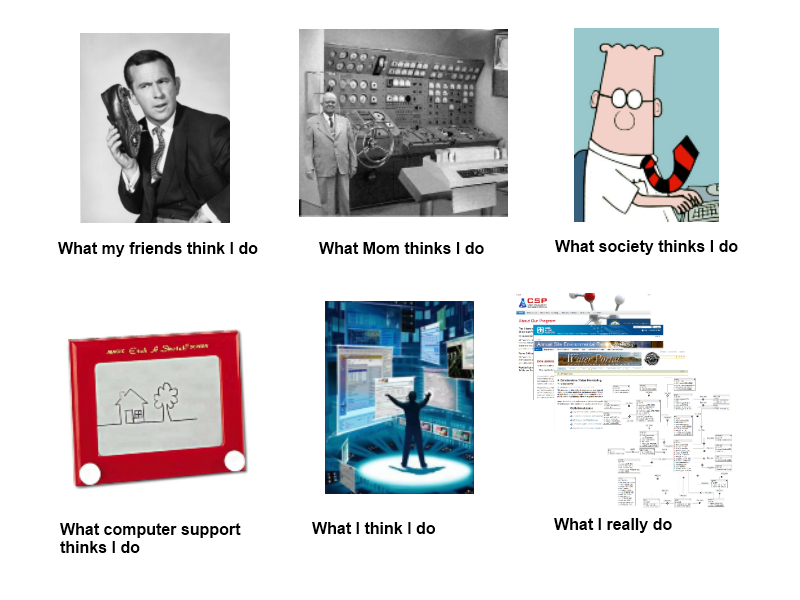
That said, I thought I'd try to capture some ideas in that latest Facebook meme, "How others see me." 

Between a fair bit of foreign travel, the geekiness of it all, and the reality on the ground, everyone around me has a different perspective.  Perhaps I'll use this for my interim performance review.

Thursday, February 16, 2012

4th Annual Great Backyard Plone Count

For the fourth year running it's time for the Great Backyard Bird Count (Plone-driven, btw) and the Great Backyard Plone Count.  While the bird count is a collaborative bird-watching effort by the Audubon Society, the Cornell Lab of Ornithology, and Bird Studies Canada, the Plone count is a voluntary effort to collect data on the world-wide distribution of Plone-powered sites.  In homage to the GBBC, the Plone count is held the same weekend, which this year is Friday 17 through Monday 20 February. 

Because many Plone sites are intranets behind firewalls, they can't be located by crawling the web.  This is a chance for developers, site owners, and users to stand up and be counted.  It's a non-scientific, totally voluntary effort for self-reporting Plone-based web portals.  Last year's results are posted at this Google Docs spreadsheet. If your input from February 2011 is still current, you're already done. 

That said, the input form on the Google Docs spreadsheet is now open.  Anyone can submit sightings of Plone in the wild.  I'll be doing some mining of Delicious and other social bookmarking services this weekend and posting them as well. 

Although there's significant bias in a survey like this, the real value comes from tracking trends over time.  This is the fourth annual Backyard Plone Count (2009, 2010, 2011) and as the number of yearly data points increase, we'll better be able to extrapolate from the observations.  It's not that we're getting an absolute count of Plone market penetrations (just like the GBBC isn't counting individual birds), it's just that we're getting a repeatable sampling by the community.  It is as more a measure of community involvement than it is a metric of the actual number of Plone sites out there. 

So get out there and spot some Plone sites -- and while you're at it, spend a little time counting birds at your feeder.

Thanks in advance!

Saturday, December 31, 2011

Plone Metrics Person of the Year

Just like every year, outstanding contributions have been made from a large number of Plonistas worldwide.  It's been a eventful year for Plone and that makes 2011's throwdown especially difficult.  Disclaimer:  Plone Metrics Person of the Year is in no way officially affiliated with Plone or its Foundation, but represents my personal effort to thank the whole community that makes the Plone ecosystem tick. 

Noteworthy contributions during 2011 that deserve a shout-out include, but are not limited to:

  • The 2011 Plone Conference people aka bunny ears (and panda hats) did a great job with this year's event.  I notice that Elizabeth Leddy, the energizer bunny of the conference, and probably some others, are missing from the Thank you page. 
  • All of those who have blogged and microblogged about Plone are another group of supporters who contribute simply by communicating your ideas, thoughts, and solutions.  Thanks to Planet Plone for pulling so many blogs together. 
  • Along those lines, Marc Corum, even thought he has stepped down from the Plone Board, is pushing to re-energize the Plone Communication and Marketing Teams.  
  • The core developers and release managers definitely need a huge shout-out for all the essential work they do. 
  • There continues to be some local Albuquerque talent in this year's nominees:  Michael Bernstein (helping out at with our Chem Security site) and Alex and Chantal at FosterMilo.
  • As always, the Foundation Board gets a great big nod of appreciation here.  Calvin Hendryx-Parker, past-Prez, gets my admiration just for wearing the shiny pants. 
This leaves me with a terrible burden--coming up with the one and only best of the best, the single Plone Metrics Person of the Year.  Casting about for some stats to back up my decidedly unscientific process leads me to the following two tables.

Table 1.  Core Developers and number of postings

Andreas Jung (ajung) 5549
Alexander Limi 2760
Espen Moe-Nilssen (espen) 1310
Martin Aspeli 1296
Jon Stahl 1257
Alex Clark (aclark) 981
Laurence Rowe 879
Graham Perrin 871
redcor 848
Mayank Patel (monks) 607
Dale DeWitt 589
George L 549
John Destefano (deesto) 486
JonStahl 464
Israel Saeta Pérez 443
Kees Hink 415
Mikko Ohtamaa 373
Eric Steele (esteele) 356
Vincent Fretin 356
Nate Aune (natea) 349

These are the top 20 people in the Core Developers forum as ranked by postings. It strongly argues for Andreas Jung to win the prize.  He's been contributing right through the holidays, not even slowing down for Festivus. If I hadn't been tipping the Aberfeldy 12-year tonight, I'd go look at the number of commits each of these have contributed in the past year, but for now, number of posts on the forum will do. 

Table 2.  Plone Foundation Board Members and Advisers with number of terms served.


Alexander Limi* 7
Toby Roberts 6
Geir Bækholt 5
Joel Burton* 5
Jon Stahl 4
Matt Hamilton 4
Steve McMahon 4
Mark Corum 3
Nate Aune* 3
Paul Everitt 3
Calvin Hendryx-Parker 2
Darci Hanning 2
Geoff Davis 2
Roberto Allende 2
Xavier Heymans 2
Alan Runyan 1
Andy McKay 1
Ben Saller 1
Bernard Bühlmann 1
Jacqueline Arasi 1
Jodok Batlogg 1
Mark Barrenechea 1
Munwar Shariff 1
Robert Boulanger 1
Sam Greenblatt 1
Sasha Vinçic 1

* Previous Plone Metrics Person of the Year

When I compiled a listing of all the past year's Board members, I was not surprised to see Alexander Limi at the top of the list.  What amazed me is that Toby Roberts is in the number two spot.  He has been the unsung hero, serving as Treasurer for every year except 2004 (when Matt Hamilton had the job). I presume he is doing the job this year, although I don't see it on the 2011-12 Foundation page.

Based on the above two tables, I'm going to toss a coin (heads: Andreas; tails: Toby).  Both have significantly contributed to Plone, both in 2011 and in the long haul.

And this year's winner of a free beer from me, is (drum roll, please)... Toby Roberts.

Just remember, Toby may be today's Plone Metrics Person of the Year, but each day every one of the members of the Plone community are winners.  And you all have my thanks.  
_______________
The author welcomes comments that commend others involved with Plone.  This brief blog post can't do justice to all the hard and creative work that's being done throughout the year.