"Count what is countable. Measure what is measureable. What is not measureable, make measureable." -- Galileo

Showing posts with label Plone. Show all posts

Thursday, December 25, 2014

'Tis the Season

Yes, it's that time of the year when everyone has misplaced apostrophes everywhere -- T'is the Season.  Just remember, "Axial tilt is the reason for the season," at least when you're an astronomer's son.  

Not only is it ChrisKwanFestNukkStice, it's just a week away from New Year's Eve.  That can mean only one thing:  Plone Metrics Person of the Year and chasing away the wolf that ate the sun (thx to @LeVostrCG).  I'm now accepting suggestions for a metric that can be used to differentiate one member of the Plone community from all the rest of this amazing group of people who keep the wheels of Plone spinning.

By way of a recap, here's past years' winners. 

2007 Alexander Limi
2008 Joel Burton
2009 Nate Aune
2010 Eric Steele
2011 Toby Roberts
2012 Martijn Pieters
2013 Elizabeth Leddy

Whether I've used personal experience, quality of contribution, OhLol measures, or something else, it's always been a difficult decision.  Too many good people doing great things.  If you have an idea for this year's metric, pop me a line @schlepp on Twitter.

Cheers!

Tuesday, July 8, 2014

Programming Languages and CMSs

Courtesy  of a link on LifeHacker, I discovered an interactive IEEE webpage that lets you slice and dice programming languages in a variety of ways.  You can sort them by ranking criteria like "trending," "jobs," "open," or customize your own ranking systems.  Additionally, you can filter them by web, mobile, enterprise or embedded language types. 

Interestingly, Python holds its number 4 spot overall and for all individual language types.  PHP follows in the number 6 slot.  PERL struggles along at 8 or lower, depending on how you select the filter settings. 

That said, it looks like Python is very much a contender in the programming language debate.  I used to teach Python to my class in algorithms because the class text, Corman and Leiserson, Rivest, and Stein's "Introduction to Algorithms," uses Python-ish pseudocode.  In fact, we'd often cut and paste their pseudocode, make a few edits, and run the algorithms with time tracking functions.  Racing algorithms--how to make O-notation fun. 

That, of course, brings us back to CMS.  A search on CMS Matrix for Python-based systems returns 23 results:
  • autowebcms
  • BlackMonk CMS
  • CubicWeb
  • Cyn.in
  • django-cms
  • DXM Multilingual
  • Easy Publisher
  • eContent 3.5
  • Ellington
  • EZRO
  • Macromedia Contribute
  • Mezzanine
  • Nuxeo CPS
  • Plone
  • PublishXML
  • PyLucid
  • Silva
  • Solgema
  • SR2
  • Web Cube
  • WEB123 CMS
  • WebEngine v6
  • zwook
A search for PHP-based systems returns 585.  (Contact the author if you'd like to see the entire listing.)

That's a fascinating mismatch between the IEEE ranking of the programming language and number of CMSs based on the underlying language.  Considering that Plone and Django are the heavy hitters among the Python-based CMSs, this puts them in a positive light. 


Monday, February 3, 2014

Plone and Mobile

In keeping with my New Year's Resolution, here's installment #2 of my promised monthly Plone Metrics.  I'm likely to be one up this month, since I traditionally run the Great Backyard Plone Count in parallel with the Audubon Society's Great Backyard Bird Count and this year that will be February 14-17. 

Meanwhile, I just finished drafting an abstract for the INMM information analysis technical meeting this May in Portland.  I'll be presenting my thoughts on mobile technologies and their impact on nuclear nonproliferation.  With that in mind, I turned to Google Analytics to see how Plone.org is doing with regard to mobile.

The data set begins in September of 2009, when Google started collecting mobile device infomation.  It's clearly increasing and in step with growth in the mobile use of the web. 


The Pew Internet and American Life Project has been tracking "cell internet users" since 2009 and the findings shouldn't be a surprise.  In 2009 31% of all cellphone users browsed the web with their device.  That has doubled to 63% in 2013.

Since 91% of Americans own a cellphone, that's 57% of everyone in the U.S. using their cellphone to access the web or check e-mail.  I assume that similar trends exist for much of the developed world.  In developing countries, matters are not lagging far behind--89.4% of the population subscribe to mobile services.  Almost 20% are broadband subscriptions.   (Thanks, MobiThinking.)

For the moment, Plone.org is growing linearly with regard to mobile.  Here's the data exported into  Open Office Calc with a regression line run through it.  The fit is reasonably good with R2 over 0.83 across 52 months of data since late Q3 2009.


Meanwhile, here's what Plone.org looks like on my Droid.  (I wanted to get a screenshot with Google Glass, but the voice recognition keeps insisting that I'm searching for "clone.") 


And here's the usual Drupal comparision.


And finally, just to widen the field a bit, here's the mobile screenshot for Liferay.


This last one is interesting because its format is one of  a long, long vertically scrolling page.  I'll save an examination of the UX of these mobile interfaces for another time.  I include Liferay here because it's only three stops away on the Green Line in Real Story Group's CMS subway diagram.


The Green Line is Portals and Content Integration.  More on this subway map later, but I need to hold back something for March. 

Sunday, May 16, 2010

Plone Rocks

I saw an Amplicate tweet a day or two ago about "Plone sucks."  Following up on that I found that there was  "Plone rocks" side of Amplicate and quickly stumbled into a world of automated Twitter stats.  Although interesting, it has some serious flaws in understanding human language, for example, the tweet "no way Drupal rocks" was counted as a positive "Drupal rocks" score just because of the literal phrase without any understanding of context.

Apparently Amplicate has only been around since October 2009, so there's not much data to go by, but still it was interesting to poke around. 


As you can see the rocks and sucks trends are roughly even.  This is actually good news because people tend to gripe more than they praise in general (squeaky wheel and all that). I'll run the test for significant differences between the two lines some evening when I'm not sipping 18-year old single malt.

More interesting than the numbers was the strange classification system.  Plone is considered a software framework.  Sharepoint is found under software applications.  Drupal is tucked away under Internet content management systems as is Joomla.


If you're feeling good about Plone right now, tweet about it with the trigger phrase "Plone rocks" and hop on over to Amplicate to add your vote to the tally of supporters.

Tuesday, April 27, 2010

CMS Security

I'm still trying to catch up on blog posts after March with jury duty and emptying out the parent's home of 40 years.  For World Plone Day 2010 I thought I'd bring up one of my favorite contentious subjects:  security.  Seems like every year some pundit runs through the security arguments for CMS.  Here's my chance to get ahead of the curve.

First, the methodology.  Candidate CMS's are the top ten listed in CMS Matrix when sorted by compares (BTW, Plone comes in sixth).  The source for my security data is the National CVE and CCE Vulnerability Database, searching each candidate CMS for vulnerabilities listed in the past 3 years and past 3 months.  The highest level of vulnerability in the past 3 months were counted and totaled as a "Seriousness" score.  Here they are in alphabetical order. 

CMS 3 yr. vuln. 3 mo. vuln. Seriousness
DotNetNuke 13 0 0
Drupal 266 16 6 medium
Joomla 426 87 36 high
Mambo 85 0 0
PHP Nuke 6 0 0
Plone 8 0 0
TYPO3 224 44 26 high
WebGUI 9 0 0
WordPress 141 6 4 high
Xoops 65 3 1 high

Second, the results.  I'm pleasantly surprised that 5 out of 10 turned up with no vulnerabilities in the past 3 months. However, of those only PHP Nuke has a better 3-year number of vulnerabilities.  TYPO3 and Joomla have a much larger number of vulnerabilities rated "high" by the National Vulnerability Database than all the rest combined. 

Typically one hears defenses like "CMS x has more vulnerabilities reported because it is more popular/has a larger install base and therefore has more eyes looking for problems."  That's the same argument Microsoft put forward for all its security flaws when compared with Linux.  You don't want to go there. 

But even putting aside the logical fallacies in such arguments, both pro and con, it's clear that systems with more security flaws require more effort to patch and lock down.  The bottom line is that more flaws mean more chances for the sys admin to slip up and more opportunities for the bad guys. 

By way of an anecdote, at my day-job our computer security people were much relieved to learn that we were using a non-PHP-based CMS.  On that note, Happy World Plone Day 2010. 

Plone and the Wonder Wheel

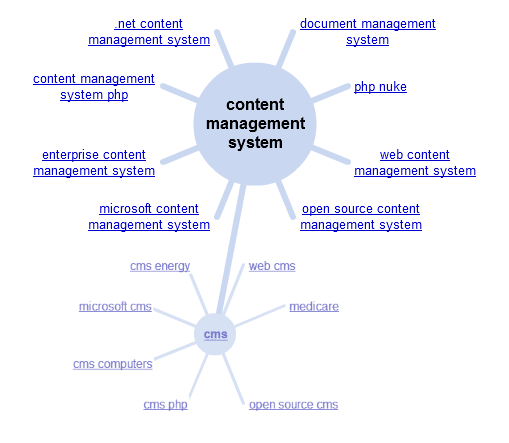
If you google for a term, let's say, "CMS," you'll notice a little "Show options" link at the upper left that you probably use for narrowing down date ranges or filtering news items and images.  About 3/4ths of the way down the list of option is one called "Wonder wheel."  It displays a spoked wheel labeled with, for lack of a better term, interesting links.  The usual top 10 search results appear in a column to the right.

From the CMS wheel, clicking on one of the spoke's links, for example, "Content Management Systems," opens a second wheel, to wit:


What I find interesting is the difference between the top 10 search results and the spokes, looking at which CMS's turn up within each "spin" of the wonder wheel.  At the first level ("CMS"), most results are disambiguation links.  The only specific systems listed are CMS Made Simple and concrete5, even though "microsoft cms" is one of the spokes.

At the second level, the spokes show ".net content management system," "php nuke," and "microsoft content management system."  The top 10 results now return a few general links plus Alfresco, Pligg, LightCMS, ModX, Drupal, Joomla!, and Plone.  Oh yes, there are some sponsored links at this point.  From here on out, there are always three commercial systems turning up as sponsored links. 

Beyond this, the combinations and alternative paths become numerous.  Following "enterprise content management system" takes us to a wheel with mostly general spokes, but two specific systems garner a spoke each.  Six of the top 10 results are specific systems, none Plone.

Backing up and following "open source content management system," WordPress, CMS Made Simple, and Drupal each label a spoke.  Six of the top 10 results are specific systems, one of which is Plone. 

Backing up once again and following "web content management system" gets us a wheel with only general categories for spokes but 5 out of the top 10 results are specific systems, none Plone. However, selecting the awkward "web content management system open source" spoke takes you to the first wheel in this chain where Plone has a spoke of its own. 

All this raises some questions:
  • What determines whether an item appears on a particular wonder wheel?  
  • What determines an item's position on the wonder wheel?  
  • Why doesn't Plone have a position somewhere in the daughter wheels of "open source content management?"  
  • What needs to be done to get Plone to turn up in more wheels?  
I guess it's that last question that I want to toss out to the Plone community as we count down the final hours to World Plone Day 2010. I can't say that wonder wheels are becoming the new way to search--for one thing, they're not available on Google's mobile page for my Droid.  But I can't help thinking that under the hood a better wonder wheel position translates to better SEO behavior in general.  Your thoughts, please.

Sunday, April 11, 2010

Quarterly Amazon Sales Rank Stats

It's time for me to pull myself away from the Herculean task of emptying out my parents' house and get back to our regularly scheduled program.  It's the beginning of the quarter when I usually take a moment to see how Plone titles are faring over at Amazon.com.  Here's the latest sales rank statistics for Plone texts: 

From the zigs and zags you can see that Amazon sales ranks, as always, aren't very stable.  Julie Meloni's "Plone Content Management Essentials" took a huge leap.  (Remember low sales ranks is a good thing.)  And in fact, just about all Plone texts improved their sales ranks.  Four books have sales ranks below 200,000 and only three had their rank go upwards (Rose, Cooper, Lotze and Theune).  Frankly, I'd have to say this trend, if it continues, could indicate a healthy turn of affairs just in time for Plone 4. 

Saturday, December 12, 2009

A Plone-Centric View of CMS Technology

Some clever person over in the Plone Evangelism Forum (Armin Stross-Radschinski) suggested that the community look at a Plone-centric subway map.  From that germ of an idea comes this modification of the CMS Watch Subway Map


This leaves a nasty jog in the Blue line where Alfresco to Typo3 now connects with the Plone station.  If I had the time and patience, I'd flip the Blue line over to the other side of the Red line and continue it in the same direction as the Alfresco-Plone leg, although that would crowd into the CMS Watch logo in the center. 

I'll leave it to CMS Watch to see if they agree with the repositioning shown above.  It echos the remarks made by Limi in this year's Future of Plone address at World Plone 2009 -- we're not competing with the Drupals and Joomlas of the world. 

To move Plone onto the main line, we'd have to add one or both of Enterprise Content Management or Digital Asset Management.  If you think about it, were Plone classified as a strong Digital Asset Management system, it would probably also meet the criteria for ECM.  It all goes back to the discussion about what constitutes an ECM.  I'm not sure that Wikipedia has the last word on that, at least at the moment.  The article there is listed as having multiple issues. 

Meanwhile, after some reflection, it occurred to me to extract the Red-Blue-Green lines and look at the neighborhood around Plone in a less cluttered view.  That led me to a Venn diagram instead of a subway map: 


This omits all the other CMS Watch categories and leaves a very clear Plone-centric picture.  Plone is running with the big dogs and its the only open source solution in the center.
_______________

In closing, we're fast coming up on the New Year and that can only mean one thing:  Plone Metrics' Person of the Year Award.  No cash, no prizes, but as they say on Iron Chef, they'll have "the peoples' ovation and fame forever."  Now accepting suggestions until Dec. 28.

Happy Plone Holidays!

Wednesday, November 11, 2009

Packt Feedback

Stoyan Stefanov, one of Packt's judges, gives a high-level overview of how he saw the non-PHP systems stack up during this year's competition. His evaluation included these bullets:
  • python
  • slick and contemporary
  • impressive list of add-ons
  • excellent step-by-step tutorials, manuals and a free online book
  • impressive client list, starting with (since I bitch about performance throughout this post) Akamai, the CDN provider
  • +1 for performance best practices
  • -10 for missing demo?
Obviously the missing demo didn't count too heavily against Plone, but it might be something that both the evangelism and hosting groups could look into.

Monday, November 9, 2009

Packt Best Other Open Source CMS Award

And the winner is... Plone!

For the second year running Plone makes it to the winner's circle and walks away with $2000. Second place went to dotCMS and third place to mojoPortal.

I still think the category should be Best Python Open Source CMS. Best Other OS CMS would then include PHP and dotNET frameworks. ;-)

Remember that this is much of a black box award, with community voting contributing to the nomination process and then final votes factoring in with Packt's judging panel in some mysterious way. None-the-less, I don't recommend that the Plone Foundation turn down the prize money.

Also remember that Packt is in the business of selling books and their judging panel would be foolish if they didn't take books sales into account. Right now their are four main Plone titles from Packt and a fifth expected any day now.

By comparison (hey, I've got to have some metrics in this post) Drupal and Joomla have 16 titles each, while WordPress only has 8.

Meanwhile Plonistas, kick back and have a well deserved cup o' joe (for those of us in the Western Hemisphere). The rest of you in Europe and Africa can go straight for other celebratory beverages. For Australia, New Zealand and the Far East, get out of bed and set off some fireworks!

Wednesday, October 28, 2009

Whitehouse.gov Goes Open Source

It was a red-letter day for open-source software when the White House announced its transition from ASP.NET to Drupal on Oct. 24. Several insightful pieces have already been written in the blogosphere (Nancy Scola and Tim O'Reilly), so I'll not rehash that here. Instead I'll do the usual and take a look at some numbers.

Some obvious choices for searching stats turn out to create problems. Uncle Sam's Google Search returns things like the National Vulnerabilities Database listing for a given CMS. Perhaps given that its 3:30 a.m., a first whack at how many .gov sites are out there using OS is to simply look at self-reporting for some representative CMS's.


CMS
Sites
Reported
Source URL

DotNetNuke
--
(No obvious collection available. If anyone knows of one, please comment.)

Drupal46
http://groups.drupal.org/node/19885 and http://groups.drupal.org/node/24119

Joomla30
http://community.joomla.org/showcase/sites/government-and-nonprofit/government.html

Plone
234
http://plone.net/sites/sites_listing?industries%3Alist=Government

WordPress
17
http://wordpress.org/showcase/tag/government/


Although its been heralded as a watershed moment for open source, FOSS has been steadily penetrating the .gov domain for years. The high-profile nature of whitehouse.gov, however, gives open source a great boost. But places like Albuquerque, Newport News, Brazil, Ireland, Italy, New Zealand, and many others have been using open source for years. I recommend reading the e-Government article in Wikipedia with an eye towards FOSS mentions, which are numerous.

As always, the message is to match requirements with capabilities. If you're a PHP shop with lots of talent in that area, you might be inclined to go in that direction. Similarly, with ASP.NET staff, DNN is a player. If security is one of your top concerns, Plone should be on your short list.

Meanwhile, here's another plug for FosterMilo's presentation at World Plone 2009 on Day 2 -- "Helping the Government Go Plone." They were instrumental in getting Plone up and running for the Cities of Albuquerque and Raton here in New Mexico. If past presentations are any indication (here's one of my favs), this will be a good one.

Tuesday, September 15, 2009

The Plone-SharePoint Chronicles

Although SharePoint and Plone overlap somewhat in feature sets, any comparison is an apples-and-oranges affair. Basically, SharePoint is a document management system while Plone is a web-publishing, content management system.

Key requirements in my situation of interest include moving draft documents out of staff inboxes for version control, providing an unambiguous story to senior management, and presenting a well thought-out and compelling line of reasoning to external stakeholders (web publishing). At the same time, draft and sensitive documents must be protected.

For any external collaborative website that requires brand identification, Plone is strongly recommended. For an internal, no-frills document collection with static folder structure, SharePoint can deliver an acceptable solution that is familiar to many users.

A hybrid solution (SharePoint internal/Plone external) will require constant manual intervention to maintain synchronization of appropriate documents. External access, for example, from partner universities, to an internal SharePoint site will not be an option. If this use-case is anticipated, a Plone-only architecture may be warranted. Otherwise, it will be necessary for core team members to look in two places (internal and external) for documents based on whether an outside editor is one of the contributors. As the program broadens, the likelihood of additional external authors increases, making this a more likely problem.

Downstream requirements expansions should be considered before settling on a final architecture. Once implemented, the management-level user community will operate with considerable inertia.


SharePoint

Plone

Microsoft SharePoint is a collection of products and software elements that includes collaboration functions, process management modules, search modules, and a document-management platform. Technically SP was released approximately in 2002 and is operating here as version 3, but its many components have a complex pedigree.

Plone is an open-source content management system and associated third-party products. First released in 2001, our planned deployment is with version 3.1, now stable for over 6 months.

SharePoint sites are functionally ASP.NET 2.0 web applications, which are served using IIS and a SQL Server database. All site content data, such as items in document libraries and lists, are stored within an SQL database.

Functionally Plone is a Python application running behind Apache in our case with a Zope database/server backend. Most site content data are stored within Zope.

Requires significant ASP.NET hand coding for modification; SharePoint Designer for customization.

Customization of data types and workflows managed through UML models; standard CSS plus page templates for look-and-feel changes.

SharePoint has an Internet Explorer–based user interface with somewhat limited functionality available to users of other browsers.

Plone is well regarded for its platform independence and browser neutrality.

SharePoint has non-trivial license fees and these are passed to line organizations as indirect costs. Direct costs of content creation and site management are still incurred.

Plone is licensed under the Gnu Public License and has no distribution fees. Costs are only those directly associated with site creation, administration, and content creation or management.

Section 508 Compliance can be achieved with SharePoint, but doing so typically requires substantial development effort, or the use of third-party products. Of particular concern in SharePoint are the use of a number of ActiveX browser plugin controls, the use of non-compliant markup, and over-dependence on client-side scripting.

Plone excels in standards compliance, accessibility (Section 508 compliance), and internationalization.

Unusable sites surprisingly easy to create by the unwary. Awkward to restructure sites at a later time.

Multiple means of organization and navigation available. Moving items does not break internal references. Full-text search available out of the box.

By means of VPN into our internal network or implemented as a site on the external network.

Accessible equally from internal or external networks. Single-sign-on anticipated shortly.

Restructuring a SharePoint site is complex and time-consuming. Data aggregation tasks are extremely complex.

Plone can be customized and extended to meet highly specific needs in terms of data aggregation, site structure, content types, workflow rules, and so forth.

Superior MS Office integration, but difficult to adjust workflow to more complex situations.

Third-party desktop products give Plone drag-and-drop capabilities. Version 3 will have inline editing.

Lacks automatic templating of web pages.

Page templating enforced out of the box.

Non-corporate external SharePoint user accounts must be managed via our internal password-control tools.

Non-corporate user credentials managed simply and locally. Very fine-grained security controls.

Both internal and external versions available with full corporate IT support.

Acceptable for OUO on our external servers. Considered much more secure than PHP-based content management systems. Supported by in-house developers.


(These Blogger table formats are really bothering me today. I've posted the full table at Google Docs.)

Reviews, Resources, and Links


Sunday, August 30, 2009

Cygnus atratus and CMS

A friend sent me a copy of Taleb's book, The Black Swan, and I've been giving it a read. One might wonder where a discussion of extreme events fits with Plone and CMS in general and I hope to close that loop before I'm finished today.

Let's start with a concrete example: the Dec. 2004 Sumatran earthquake and tsunami. Without getting into a debate about whether large earthquakes are true black swan events, this certainly fit the bill for millions of affected people.

In Nov. just prior to that, Enfold Systems launched Oxfam America's newly designed Plone portal. From an item at AllBusiness.com,
"In the course of ten days during the Tsunami crisis, Oxfam had almost half of its typical yearly visits, and almost 1/3 of its yearly bandwidth -- the system performed beautifully," said Internet Manager Nicholas Rabinowitz.
Oxfam raised $14M and credited Plone with a large part of making it possible to handle the scale of the relief response. Clearly this is an example of an enormous negative black swan event for people in the Indian Ocean basin, but a positive black swan event for Plone. This is exactly what Taleb promulgates as a successful strategy for managing risk--maximize your exposure to positive black swans.

Let's take this concept a step farther back and look at the general CMS environment. In the first decade of the 21st Century, we've seen CMS go from twinkle in someone's eye to dozens of major systems. The diffusion of the CMS innovation has been marked by a rapid evolutionary radiation into hundreds of web niches.

Many CMS niches are characterized by what are called path dependencies and network externalities. A path dependency explains how one set of decisions is constrained by what previous decisions. Vendor lock-in is a classic case in point that results in positive feedback for a particular, although possibly suboptimal, solution.

An organization that has drunk the Microsoft coolaid may very likely go with SharePoint as their document management solution and try to foist that off as a web publishing solution as well. But the original choice to go with MS may be a black swan in that it was a very rare, high consequence event from a software perspective.

Network externalities are where outside events drive a decision. Often this means that someone makes a decison to implement a particular CMS because its considered easier to find PHP programmers. (Don't get me started on the ease of learning Python and the readability of Python code.) What was the black swan that led to PHP predominance in web apps? I would hazard that the success of Apache running largely on Unix with tools like AWK led straight to second generation software like Perl and PHP.

I'm now seeing items in the innovation literature that point to yet a third factor that drives acceptance: lack of information. This lack of information on the relative merits of systems leads decision-makers to base their choices on whatever data chance has delivered to them. I've heard this refered to as the "PC Magazine-Air Travel Model," where a manager's decision is based on whatever he or she read in PC Magazine while flying back from DC.

In conclusion, I can't say I believe everything that a catastrophist like Taleb writes. As an evolutionary biologist, I'm well aware of the impact of catastrophies on evolving systems (for example, asteroids and K-T extinctions). But I feel the overall grist in the mill of complex systems is the day-to-day micro-improvements, whether a small favorable mutation or a PLIP solved by a Plone developer. Black swans are out there and we want to be the lucky ones who seize the opportunities they bring, but that doesn't mean I'll stop working on the small, almost unnoticed improvements that drive system change.

Saturday, August 1, 2009

Trends from Builtwith

I just found BuiltWith Trends, which has some interesting CMS data among other things. My understanding is that they sample a large (but unspecified) number of domains and determine the web technology used. Looks like they're only publishing data beginning late last November.

The graph here definitely puts the Google Trends stats in perspective. I've extracted the individual data for a couple CMS and compiled them into one chart. It turns out that Joomla and Plone each account for a tiny fraction (<0.02%), whereas Google Trends shows Joomla far outstripping Drupal. Speaking of Drupal, they just recently scrabbled above 1.0% after bottoming out at 0.70% last Christmas.

At the bottom of each technology page is a pie chart showing how the last survey slices the entire domain, in this case, CMS. Drupal's 1.35% is 38.5% of all CMSs surveyed. Joomla comes in with 5.13% and Plone has 1.71%. In terms of ranking, Drupal is on top, Joomla is fifth, and Plone ties for eighth.

BuiltWith conveniently lists top sites using a given technology, although I'm not sure how they determine this. Plone's top sites are the CIA, Discover Magazine, ACM, and Connexions. Typically BuiltWith lists a maximum of 20 top sites, so I'm not sure how they missed Oxfam America, NASA Science, and a couple thousand others.

Just to give you an idea of the other's top sites, Drupal's top 4 sites are BrightCove, Us Magazine, iVillage, and NW Source. Joomla's are The Hill, RCN, SpellingCity, and everythingiCafe.

Clicking on a listed site will take you to a summary page that displays all the technologies that BuiltWith was able to extract from the domain in question. Very interesting stuff.

Like all web stats, they are to be used cautiously, all the more so when an explicit methodology is not stated. None-the-less, I'll definitely be following BuiltWith to see how things track over time. There's considerable noise in the data and one can't yet tell a trend from seasonal noise or something associated with a new version rollout.

All that said, this may be as close to market share as we're likely to get in the near future. The numbers don't segment the marketplace, so we still don't know if Plone is killing Drupal or vice versa in the government, education, and not for profit areas. Quite frankly the big surprise for me was that the total usage percent for CMS is only 3.67% of all the sites sampled by BuiltWith. Looks like global domination is still a ways off.

Sunday, April 12, 2009

Plone and SharePoint

Before I get down to business, I thought I'd mention Packt's new release, "Choosing an Open Source CMS: A Beginner's Guide" by Nirav Mehta. At first blush, I was a little put off by the self-demeaning subtitle, but upon reading the Packt material more closely, it looks like anyone in the CMS decison-making hierarchy could stand to give this one a read. At the very least, it repeats my mantra of "Requirements, requirements, requirements" as the first step to solving a problem.

However, without having seen the text, I'm a little worried that it is a marketing ploy for WordPress, Joomla, and Drupal. The online material specifically calls those three out when it talks about the book having quick-start guides and examples. It would be a pity that a good concept should be ruined by having pre-conceived solutions that fly in the face of their own advice to let requirements drive the CMS decision.

I wonder where Plone will fall in their section on "CMSs by Breed?" Interestingly, in the final chapter apparently they reiterate the results of the last Packt open source CMS award winners. That certainly opens the door for Plone, but a final call will have to wait until I get my hands on a copy.
________________

Meanwhile, on to tonight's topic: SharePoint. At my day-job I continue to see the corporate SharePoint solution spread (more than 1000 sites currently listed internally). The beauty of a corporate SharePoint is that it has no impact on a project's bottem line--its just another cost subsumed in IT overhead.

That makes our skunkworks of a Plone shop expensive by comparison, since we bill our services directly out of someone's program budget. Even so, Plone offers enough advantages over the alternatives that we stay very busy.

I've had my share of anecdotal evidence about how SharePoint and Plone differ on their implementation, but the sparkplug for all this is Bryan Ruby's CMS Report last month entitled "The Problem is Bigger than SharePoint." Bryan's piece put me on to Thomas Vander Wal's post, "SharePoint 2007: Gateway Drug to Enterprise Social Tools." Both are well thought out articles with a healthy dose of comments from all sides of the issue.

What seems to be drawing in customers are a few key capabilities:
  • Online forms. PloneFormGen and the ability to permit anonymous submission of completed forms, for example, workshop registration or non-citizen visit request.
  • Document sharing. Getting the traditional webmaster out of the way so site owners can upload their own content using their own folder hierarchy.
  • Customizable workflow. Special roles for individuals and groups, perhaps for just a particular subset of the portal.
  • Unique content types. Archetypes generated from UML models to handle special use-cases.
  • Versioning. Tracking document revisions really cuts down on e-mail glut.
  • Flexible theming. The ability to skin a site quickly to either the corporate standard or a particular project's own brand.
  • Automatic indexing/full-site search. Need I say more.
  • Broad collection of 3rd party products. The need for questionnaires, surveys, inventories, calendars, wikis, workgroups, and other features are often solved with a product "off-the-shelf."
That's a surprisingly modest list of functions and it seems like SharePoint would do some of these as well as or even better than Plone. But I have to agree with Bryan that SharePoint and many enterprise systems are caught between two worlds and not doing the social collaboration side of the solution well.

Saturday, March 21, 2009

Usability of CMS Home Sites redux--the new Plone.org

The much anticipated Plone.org redesign has rolled out the door this week and from what I've seen on Twitter, its a winner. From what I've seen myself, its a winner. Welcome to 2010, Plone... 2010 and beyond.

Admittedly, I've got a soft spot for Plone, using it in my day job for implementing a variety of web projects. This week its been a portal for an upcoming UNSCR 1540 workshop. Last week it was a global security website. The week before that we used it as the modern front end for a legacy distance learning tool. So how's a guy supposed to be unbiased?


Let me turn back the page a month or so to my posting on usability and see how the new Plone.org stacks up with the old. Recall that I was ranking sites based on how few of Jakob Neilsen's "Top Ten Mistakes in Web Design" are evident. Low numbers mean fewer usability mistakes and a better home site.

Mistake

Old Plone

New
Plone
Observations

Bad search


PDF files for online reading


Not changing the color of visited links


Non-scannable text 0.5
"F pattern" fully embraced
Fixed font size


Page titles with low search engine visibility 1
1
Buggy but expected to improve
Anything that looks like an advertisement


Violating design conventions

0.5
Hyperlinks within text block non-standard
Opening new browser windows


Not answering users questions 1


Targeted straight-forward references
Total
2.5 1.5


Plone. The homepage is very clean and now displays key information in the highly scannable "F-shaped" pattern that eye-tracking studies have shown is common when users are looking for something. News and upcoming events are in an unobtrusive font even though centrally placed--easy for the eyes to jump past if that's not what you're looking for. Large event graphics, which are, in a manner of speaking, advertisements from a newbie's perspective, are out of the way yet easy to find for community members (and exceptionally well integrated into the design, too). The main tree branch graphic perfectly captures the eyes' flow of vision, taking the new site visitor straight to "Explore the possibilities." On top of all that, the opening-bud theme resonates with me personally since I'm a reformed botanist.

Page titles remain tricky in the documentation and could be better for internal search engine visibility. There appears to be a bug in there--I found myself at a login screen when searching for "lock down your site."

The marketing box at the bottom of the page is gone, replaced by a concise block of text that addresses key pain points that potential Plone users might be bringing with them as they visit the site. It took me a moment to realize that the bold text represents hyperlinks--0.5 point off for not following standard hyperlink conventions here.

Plone.org now has only 1.5 of Neilsen's baddies, a 40% improvement over the previous 2.5 score and a 10% improvement based on the total scale maximum of 10.

Does anything give me real heartburn here? Nope, I'm very impressed, especially when compared with the numbers other CMS were scoring (5.0 - 6.0).

I was a little surprised when the "best security" link took me to CVE but not the pleasantly empty query page for Plone in the last 3 months or at least the NVD search page. Considering how unusable the CVE/NVD pages are, it might be better still to set up a dynamic page drawing down CVE counts for a couple dozen CMSs. (I think by making a criticism like that, I just volunteered for some Python scripting to solve the problem.)

I was a little distracted by the out of focus portions of the main graphic, but the longer I look at it, the better I like it just the way it is. There's also something just a little off about the Plone logo on the box, but its probably just the perspective being used on the angled container. Nice use of a single wet-tile graphic there--that's an often overused motif.

I saw a reference to "total world domination" with a trademark logo on the "New look" page. Not sure what that means, but I'm still leary of the concept based on my March 7 posting.

I do miss the colophon proper, if only because its a great printer's term to throw around at parties. That said, the footer is an outstanding example of how to arrange information so that its available but not in the way. Most site designers, including the old Plone.org, would highlight that material at the very top of the page and really cut down usability.

For those that haven't clicked on the "A new look for plone.org" news item and read all the way down to the "We'd like to thank the Academy" section, here's the list of those who made this possible:

  • Iain Claridge of Netsight, who did the graphic design many moons ago, and kept improving it,
  • Alexander Limi, Plone co-founder, who translated it into a simple and elegant Plone theme of real live HTML and CSS on top of xdv/Deliverance,
  • The amazing plone.org admin team, who brought plone.org into the modern age by upgrading us to Plone 3, and continued improving the site and its setup:
  • Alex Clark
  • Laurence Rowe
  • Tarek Ziadé
  • Alexander Limi
  • Steve McMahon
  • David Glick
  • Matthew Wilkes
  • Martin Aspeli
  • Graham Perrin
  • Ricardo Newbery
  • Ian Bicking,
  • Paul Everitt and the crew at OpenPlans, who created Deliverance (and its sibling: xdv), the new theming system we’re using.
  • The many people who updated, edited, rearrange and revised plone.org content in preparation for the relaunch.
In conclusion, I won't just give a tip o' the hat to the design team that rolled out the new Plone.org. I genuflect in their presence. Terrific job, everyone. Awesome!

Saturday, February 7, 2009

Usability of CMS Home Sites

Color in the News

An interesting article on color and cognition turned up in Science today and its making its way into the mainstream media. The long and the short of it is that the color blue unconsciously enhances the performance of creative tasks. The color red unconsciously enhances the performance of detail-oriented tasks.

I think the take home lesson in terms of home site usability is that, all other things being equal, one should emphasize blue on those pages whose purpose is to elicit a positive decision about a CMS product. I believe that evaluating software and making a go/no-go decision is a creative task. Detail-oriented tasks (which would involve red pages) are in-depth analysis and feature comparison, more like reading and digesting CMS Matrix results and such.

Usability, Part 3

I'm continuing with my review of CMS and usability, triggered by my elderly parent's difficulties with accessing information on the web. I certainly can't survey hundreds of various CMS implementations and I don't have a handy panel of users to conduct timed usability tests, so I'm looking at something a little less ambitious (and a good bit less rigorous). I have scored each of the parent sites of a few top-flight CMSs against Jakob Neilsen's "Top Ten Mistakes in Web Design."

For the moment, I've limited my study to plone.org, drupal.org, joomla.org, and dotnetnuke.com. The results are displayed in two tables, again due to my CSS not displaying wide tables. Italics are simply to visually separate rows. The snippets of text are to help readers link a particular score with a discussion item in the paragraphs below.

The results have been enlightening and they mirror my earlier heuristic look-and-feel analysis. In the tables below, I've scored a point for the presence of each of Neilsen's top ten mistakes. Half points were given where the flaw was not deemed egregious or of minor impact. I urge readers to go to AlertBox and get the full description of Jakob's top ten mistakes.

Mistake

Plone


Drupal


Bad search


PDF files for online reading


Not changing the color of visited links

1 #0062A0 and #027AC6
Non-scannable text 0.5 No "F pattern" 1 Walls of text everywhere
Fixed font size


Page titles with low search engine visibility 1 "How to" 1 "Join"
Anything that looks like an advertisement

1 True advertisements
Violating design conventions


Opening new browser windows


Not answering users questions 1 "Market-ese" 1 Reverse chronological listing on homepage
Total
2.5
5

Plone. The homepage is mercifully uncluttered, but doesn't display information in the highly scannable "F-shaped" pattern that eye-tracking studies have shown is common when users are looking for something. Page titles in the documentation could be better and its often difficult to find a specific article unless you remember the exact wording. Try to "lock down your site" so people can't "join as users?" You have to search for "Close your site." Plone also has far too many items that start with the phrase "How to...." And finally items in the marketing box at the bottom of the page use catchy phrases that don't necessarily fit with the questions or concepts that a prospective new user might have. None-the-less, Plone.org had only 2.5 of Neilsen's baddies.

Drupal. Meanwhile, the heaviest hitter among CMS has a much weaker home site. Visited links barely change color, large walls of unscannable text are everywhere, and true advertisements are prominent. While it has an obvious simple search box, trying to "lock down your site" so people can't "join as users" results instead in hundreds of items about using "join" in queries. The lengthy reverse chronological listing of news items only serves to obscure important, basic information that first-time site visitors might be looking for. Drupal comes in with a disappointing 5 out of 10.

Mistake
Joomla
DotNetNuke

Bad search 1 No search box

PDF files for online reading


Not changing the color of visited links

1 No change at all
Non-scannable text 0.5 Mini-walls of text 1 Icons scattered; menu bar; "toolbar"
Fixed font size


Page titles with low search engine visibility 1 No "How to" 1 No "How to"
Anything that looks like an advertisement 1 "Contribute" icon 1 True advertisements
Violating design conventions 1 No "Home" 1 Pulldowns interfere with toolbar icons; no "Home"
Opening new browser windows


Not answering users questions 1 "What is?" 1 Questionable relevance; Where is the documentation? "Downloadable files"
Total
5.5

6


Joomla! This was the only home site that lacked an obvious simple search feature. When I finally found a search box one level down, its advanced search was useless to an outsider. How would I know to search a "chunk talk," a "transwiki," or a "JDOC?" Its first page text areas were reasonably deployed, although not in an "F-pattern," but each was a monolithic mini wall of text. The look-and-feel of the documentation area was completely different from other pages. The "Contribute" link looked like a pitch for money, and their was no explicit "Home" link on many pages nor easy to recognize bread crumbs. It took some getting used to the non-standard nav menu with its confusing "Main page" and "Main" links that went to different places. Finding "How to" documents was frustrating. Perhaps worst of all, there are things like the "Getting Started" link, which takes you to a "What is" section where the download link is buried below many column-inches of scrolling text. Joomla's site was beautiful and balanced but inconsistent not very usable with a score of 5.5.

DotNetNuke. This site had a number of Neilsen's sins. Visited links didn't change even slightly, icons were scattered across the page in both a panel of images and in a toolbar-like menu. The text menu bar expanded down and interfered with seeing the icons below and was awkward to clear. Finding "How to" information or any documentation at all was difficult. Why would I look under "Downloadable files" to find documentation? When I did search for items, the returned set was of questionable relevance. My question about "locking down a site" returned results that were absolutely off mark. The presence of true advertisements detracted from the main purpose of the site, unless the main purpose is to generate revenue for sponsors. DotNetNuke came in at the bottom of our four sites with 6 critical mistakes.

Summary. Clearly and not unexpectedly, all four CMSs have some weaknesses. Surprisingly, Plone comes out ahead of the pack while the other three had 5 to 6 of Neilsen's top ten usability mistakes.

Monday, December 29, 2008

2008 Recap

Not much new in the CMS world this evening, although with all the distractions in my life at the moment, I'm sure to have missed something significant. I did turn up a December "how to choose a CMS" article and a nice write up on Plone in Italy. Also worthy of note from late November, is the announcement that Joel Burton and Roberto Allende have been named to the Plone Foundation's Advisory Board.

All that aside, I thought I'd take a stab at summarizing 2008 from the point of view of Plone Metrics. You'll have to set your way-back machine to 5 Jan when I endorsed Obama based largely on his tech-savy approach and alignment with my international work. After that I explored Google trends, where Plone's slow downward slide continues to this day. Of particular note is that World Plone Day (labeled 'E') made a blip in the news references and a significant peak in search volume.

Since then this blog has explored YouTube stats like Eben Moglen's 2006 Keynote (still getting dozens of views per day), comparative analysis of CMS entries in Wikipedia, and an initial look at the numbers in CMS Matrix.

February brought the first Plone Strategic Summit and some introspection about who was searching for what when they stumbled across Plone Metrics. Some permutation of "CMS file sharing" turns out to be the winning search terms.

March found excitement in Tibet, Plone Symposium East, and some JBOSS musings. April turned up the first references to World Plone Day and the NOLA Plone was getting finalized. I took my first foray into Technorati and blog posts. Plone does extremely well in the metric of posts/blog.

In May I was sent to Turin, Italy to listen to requirements for a UN agency's knowledge management system. I also got to meet Dr. Bates Gill of SIPRI, who interestingly are using Plone for their nuclear nonproliferation portal. In June we took a look at Simpson's Paradox and CMS Matrix ratings plus an analysis of NTEN's CMS satisfaction report and quarterly Amazon stats.

July turned up the SourceForge Community Choice Awards, more anecdotes about file sharing and CMS, and some further anecdotal items from TED (Technology, Entertainment, Design). August was a month for the Bossies, some political potificating, and some interesting visualizations of various CMS home sites. My first piece about using Plone for teaching back in August turns out to be one of the most frequently visited pages. I hope other database design instructors are using Plone and Zope as exemplars of OO databases.

A discussion of hybrid Plone-SharePoint solutions, the Connexions piece in the NY Times, Hurricane Ike and Enfold, and a look at the Plone.net numbers kept things interesting in September.

October was an exciting month, what with Joel's Bootcamp ahead of the 2008 World Plone Conference. I converted a set of Drupal online graphs into corresponding ones for Plone and I see that they are "live," continuing to display the most recent time intervals. The month ended with Martin Aspeli receiving a Packt award for Open Source CMS Most Valuable Person followed a day later by Plone taking top honors for Best Other Open Source CMS in Packt's annual survey.

In November I posted about strategies to get high visibility with Amazon sales stats when new Plone books roll out. There were also postings about developer community growth and, of course, World Plone Day. Oh, yes, there was this minor election in the U.S.

December has turned out to be a quiet month for me, not by choice--elderly parents took priority. Even so I managed to sneak in my quarterly Amazon stats and a posting about database design and manual vs automated methods for modeling and normalizing data schema.

In conclusion I'd like to thank the many readers who have supported these efforts. The numbers at Google Analytics show a slow but steady rise in readership. I'm not ready to quit my day job yet and you'll not see ads on Plone Metrics unless I'm trying to determine some parameter associated with Plone marketing.


All that's left is to come up with Plone Metric's Person of the Year. Feel free to make nomenations via comments and I'll take them under advisement.

Tuesday, December 23, 2008

Manual vs Automatic

One of my YouTube videos for my College of Santa Fe course in database design picked up an interesting comment the other day. The respondent said, "I'd personally never hire a DBA that lacked the ability to normalize using method #1 [manual normalization]." My answer in turn has a bearing on Zope, Plone, Python, Archetypes, and Joel Burton.

I'll admit that I've been paying my rent in large part based on the skills that I learned back in the 80s from my Oracle Masters classes on manual normalization. But today a machine can generate a model or SQL more quickly and accurately than a human.

With frameworks like Zope and Plone out there, I'd much rather have a good object-oriented person working for me. In the end, its going to be job requirements that should drive any hiring decision, not some a priori statement. One could equally say that I'd never hire a printer who couldn't illuminate a cover page by hand.

I am reminded of my graduate statistics professor (Dr. Karl, UA) who taught us this bizarre matrix method for computing the solution to ANOVA problems. Even in matrix notation, to get an exact answer, sums of squares had to be painfully cranked out on a hand calculator. And interestingly, he never asked for an exact numeric solution, only the matrix formulation.

A year later I was hired as a post-doc at the NMSU Dept. of Horticulture to do onion karyotyping and agricultural statistics. A program named SAS was used there. It only required that I put the data in a Fortran-like data file and define the problem as a matrix solution. Exactly what I was taught. I never had to manually calculate a sum of squares--the machine did all the grunt work.

What I want in a new hire is someone who understands objects conceptually and can use whatever tools are handy to generate a data model, a needed SQL statement, or a Web-enabled form that interacts with a backend database. While its handy to have a fundamental understanding of normalization, a high level of skill in manual normalization isn't usually needed.

Now in the Zope/Plone world, my webmaster (not a Python programmer at all) can build a UML model, run the ZARGO file through Joel's web tool, and unpack the archetype in the correct Plone products folder. A trivial amount of Python is all that is needed to manually change simple things like misspelled labels, incorrect widget types, and so on.

Being able to go from UML to functional Plone product so easily is one of the incredible benefits about using Plone as a CMS. Its hard to imagine how people work in SharePoint, Drupal, WordPress, or Alfresco without such a capability.

Saturday, November 1, 2008

Drupal -- Plone -- DotNetNuke

I've been playing around with a logo for the blog and came up with this. It also might be useful for the Plone Metrics and Statistics group over at OpenPlans. It does occur to me that its a repurposing in part of the Plone logo, so I should check with the Plone Foundation about the proper way to handle this.

Today's topic is the Packt Publishing Awards now that the overall winners have been announced. Something doesn't seem quite right. The logic of the matter goes like this:
  1. In the non-PHP category Plone was first, dotCMS was second, and DotNetNuke was third. Thus, Plone ranks higher than DotNetNuke.
  2. In the PHP category, its Drupal > Joomla! > CMS Made Simple.
  3. In the overall category, it turned out Drupal > Joomla! > DotNetNuke.
Hmm? Recall that Plone was a finalist in the overal category. Since from (1) above Plone ranked higher than DotNetNuke, one could infer that it should be somewhere to the left of DotNetNuke in (3). The question becomes, where did Plone end up in the overall category and why was it not ranked higher than DotNetNuke? Or put another way, why didn't DotNetNuke beat Plone for the non-PHP title?

Curious.

From the inconsistency in the results, we can't compare Plone with Drupal and Joomla!. How can Plone be ranked simultaneously both higher and lower than DotNetNuke?

The answer may lie in the fact that the Packt voting process separates the votes for each category. I would suggest that DotNetNuke fans voted well in the overall category and then forgot to punch in also for the non-PHP category. Does this mean DotNetNuke voters haven't noticed that their favorite CMS isn't PHP based? Or perhaps Plonistas only voted in the non-PHP category and didn't go to the overall section.

But then there's another factor at work here: Packt judges used an undisclosed method in addition to the popular vote to rank the contenders. I have no idea how number of Packt titles (Drupal 9, Joomla 9, DotNetNuke 3, Plone 3), sales figures, and so on might influence the judges. One might expect that the Packt Awards are foremost meant to benefit Packt by selling more books. In the absence of a public, objective methodology and with the inconsistent ranking of Plone and DotNetNuke, one can only guess.

Whatever the actual phenomenon, it points out that one can take these kinds of popularity contests only so far. Yes, we can now market Plone as the top non-PHP CMS for 2008 and that has a certain cachet. And I'll admit I was thrilled to see Tuesday's result roll in.

But deep down, it isn't popularity that should guide your software choices. True, highly popular systems will likely have more consultants, a larger professional base, and possibly a longer useful life. But that doesn't guarantee that the popular use-case is going to match your use-case. Other requirements need to be factored in--your internal support capabilities, deployment platform, user environment, security, overall goals, and many other needs.

In my case, our predisposition for Python and the need for a secure system were the key factors that drove us to Plone. The National Vulnerability Database lists ten records for Plone over the last three years. Drupal shows 158 records; Joomla! 265. Or put another way, "...it's striking that three [Drupal, Joomla!, Wordpress] of the Top Ten contenders on IBM's security worry-list have PHP in common. You can read whatever you want to into that, I suppose." (Kas Thomas, 8/2008)

For me, that's the end of the voting.