"Count what is countable. Measure what is measureable. What is not measureable, make measureable." -- Galileo

Saturday, October 6, 2012

Last year (Sept 2011) I responded to a series of questions on LinkedIn with a piece that looked at a number of CMS metrics that are commonly used.  These include the Real Story Group CMS subway map, some CMS Matrix numbers, the security vulnerabilities at NVD, and some notes from Google Analytics.  With the World Plone Conference getting set to kick off in Arnhem, it seems like a good idea to run these numbers again and see where we stand.

Where is Plone used, functionally?  The Real Story CMS subway map shows some interesting changes with categories up to 8 from 7 last year.  Plone still lies at the intersection of three lines, the only open-source CMS to cover Web Content & Experience Management, Portals & Content Integration, and Collaboration & Social Software.  You need one of the heavy hitting commercial vendors like IBM, Microsft, Oracle, or OpenText (formerly Vignette) to get the same combination of capabilities. 


 Geographically?  Once again, as a proxy I'm using the locations of Plone.org site visitors as visualized with Google Analytics.  Plone is used world-wide, although it's most commonly found in Europe (45%) and North America (24%).  Both have lost a couple percentage points because Asia now comes in with 16% (+3) and  South and Central America with 10% (+2).  Oceania with 3% and Africa with 2% remain steady.  As always, Plone has one of the strongest i18N capabilities of any major CMS. 


What kind of companies are using it?  From Plone.org we can track down a large sample of self-reported sites that use Plone that are conveniently categorized by type of company (61 of them, no less).  Non-profits (15%), government (14%), and education (11%) top the list, taking 40% of the pie.  Down from 44% last year are the 32% grouped into "Other," each of the 51 remaining with less than a 3% share of the pie. You can visit Sites that use Plone for the full list and lots of beautiful exemplars. 


Growth potential?  (Is Plone competing with Drupal and Joomla?)  Plone is always being compared with Drupal and Joomla because it's an open-source CMS.  But Plone has never focused on the free or low-cost mass market.  Instead Plone has built up an ecosystem of professional consultants and businesses that provide the enduring value. 

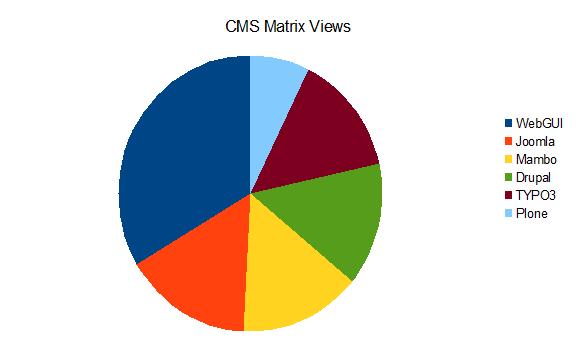
With it's fine-grain security model, powerful workflow engine, high usability, and large feature set, Plone remains one of the top CMS today. CMS Matrix shows Plone to be one of the top six most frequently viewed CMSs in their exhaustive listing of over 1000 systems. 


How secure is Plone?  Plone continues to be the most secure of all the major CMS.  The National Vulnerability Database shows Plone with only 10 issues in the past 3 years.  Drupal had 232 in the same time interval, Joomla had 404, and WordPress had 127 (a 36% increase over last year's 3 year running total). Yes, that tiny blue sliver is Plone's share of this group of CMS's security vulnerabilities.


As the Sirius Cybernetic Corporation says, "Share and enjoy!"


Wednesday, July 4, 2012

Confirmation Bias in Software Comparisons

I'm definitely guilty of confirmation bias... frankly, it's part of my job to justify the software tools that my team uses.  But I'm not a paid Plone consultant, so I don't have a conflict of fiduciary interest.  This blog is a voluntary effort completely independent of the Plone Foundation. Full disclosure:  my web team at my day job implements and manages Plone sites. 

What Paul Kaiser is doing, since he makes a living off of the WordPress ecosystem, is criticizing a system with an eye towards bolstering his own line of work.  Since he does make a living with WP, he has a genuine conflict of interest.  To his credit, he makes full disclosure of this.

His recent piece about Plone vs WP has garnered thoughtful and measured responses to clarify some of the statements.  Plonistas David Glick, Alex Clark, Eric Brehault, David Bain, and Matt Hamilton have quickly stepped in to provide the Plone point of view.  Paul's responses have been equally civil, so here's a tip of the hat to polite, open discourse, sharing of ideas, and no flame wars. 

Here are my thoughts, taking Paul's points one by one. 

Straight away Kaiser gives a nod to Blender, PyGame and Trac.  Django, Pyramid, TurboGears, and other top-flight Python frameworks are left off the table.  In the comparison of underlying languages, take a look at http://time2hack.blogspot.com/2012/01/php-vs-ruby-vs-python.html#axzz1zfOHeTNY for a recent set of stats re:  Python, Perl, PHP, Ruby, etc.

But then this is a "WP instead of Plone" article.  Move along, nothing here....

Plone != Harder;

Matt Hamilton's reply covers the misconception that Plone is harder to install, maintain, and develop.  When I was teaching at the College of Santa Fe, we'd install Plone, build a UML model, run it through ArchGenXML, and have a custom archetype all in a single evening.  It probably comes down to the background and experience of the implementer.  More about that down below under human factors. 

Regarding the other points in this section:

1.  "Fewer commercial web hosts support..."  Physical proximity is not the be-all and end-all that it once was.  With cloud-based deployments, this will be less so in the future.  If you control your own servers, it's not nearly such an issue.  We recently lost our long-time sys admin, but a new fellow with no Plone/Zope experience picked it right up.  With his CENTOS background and the clear Plone 4.1 documentation, he was able to build our new cluster without supervision by me. 

2.  "...PHP, MySQL, and WP [programmers] are far easier to locate..."  This opens the entire out-sourcing can of worms.  Take a look at the discussion at http://forums.whirlpool.net.au/archive/1772689, for example, or this interesting anecdote (http://www.electoral-vote.com/evp2012/Pres/Maps/May31.html#item-2). 

All those Plone advantages

Plone _is_ more secure.  David Glick's comment is absolutely on target -- Plone has an order of magnitude fewer vulnerabilities.  This doesn't mean that WP is less secure, it just means you must spend lots more time patching your installation.  It also means that there's more of an opportunity to miss something. 

Plone is faster.  Again David's comment is a good one.  Both WP and Plone can handle loads if configured correctly.  That said, these kinds of stories seem to be a staple of Plone:
Faster and more scalable.  No, using the ZODB isn't cheating, it's good design.  Systems running in front of MySQL just have to live with all that comes with it:  slower out-of-the-box speed, less security. 

Document Management Functions

I manage websites for my neighborhood association and the Albuquerque Bonsai Club, both WP sites.  I shudder to think about scaling these up to handle thousands of documents.  I have Plone sites with tens of thousands of pdf's, LDAP integration, complex workflows, formal review and approval processes, versioning, and multiple languages to boot.  Despite what Kaiser says about WP ease of use, I find Plone far easier to deal with than the two WP blogs I manage.

Customer experience and background count for a lot when you must satisfy a client.  In the end it comes down to listening to your customer and matching requirements to systems.  WP was designed to be a blogging system and that architectural history burdens it's ability to easily and efficiently handle document management use cases. 

Search.  David Bain's comment pretty much covers this.  Nuff said. 

Dealmaker:  Human Factors

Yes, people use the tools they are familiar with.  Typically that means an organization has evolved to have staff skillsets with flexibility and extensibility to handle their current and plausibly foreseen use cases. 

Existing skills and installed systems are themselves aspects of requirements that need to be assessed as constraints.  I won't hire a Ruby developer for a one-of-a-kind project even if using in-house Python talent is not most cost effective; it is an optimum use of HR resources.  The overhead of hiring is an indirect cost that would need to be considered and I'd be left with a under-utilized Ruby developer afterwards.  If you have outsourcing and consulting options available to your client, then that's another situation. The entire system within which software is to be recommended has to be considered by the analyst. 

Weakness in complexity.  From my background in ecology, complexity actually generates stability.  I'm seeing that in software systems as well, depending on how you define "complexity."  And if a four-layer technology stack is too much to handle, you'd better stay away from the likes of these listed here (http://www.tutkiun.com/2011/07/web-technology-stack-analysis.html).  Complex technology stacks, especially in the open-source arena, are generating co-dependencies that actually strengthen them in what mirrors co-evolutionary adaptations between biological species.

If the final analysis hinges on the human side of the equation, one only has to participate in a Plone sprint or conference (not to mention other communities involved with Zope and Python) to see that Plone wins this hands down.  In researching Plone and WP conferences this evening, I was astonished to learn that WP's first international conference was only held in 2011.  Plone Conferences have been alternating between Europe and North America since 2003 (New Orleans, followed by Vienna 2004). 

In conclusion...

I'd like to go back to Paul's initial paragraph:
"Plone is a web-based content management system built on Python, sharing many similarities with WordPress. As a WordPress developer, you may from time-to-time find clients leaning towards Plone. Learn the important differences between WordPress and Plone, and you’ll be better prepared to help such clients."
I'd take issue with the "sharing many similarities" part.  Although the Real Story Group's CMS Subway Map considers Plone and WP to be on the "Web Content Management" and "Collaboration & Social Software" lines, Plone is one of the few CMS's on those two lines that includes the "Portals & Content Integration" line.  RSG places WP far, far from Plone, and also far from Drupal and Hannon Hill, WP's colleagues on the red and blue lines. Alex Clark's comment on feature-for-feature comparisons are very relevant here, as well. 

CMS Matrix shows Plone to rank higher than WP when ordered by clicks (10:33) and views (6:13).  That's indicative of WP being the choice for many people who select it without due diligence because of its low- or no-cost hosting and ability to meet simple use cases.  Plone, by contrast, is considered by those making thoughtful, feature-by-feature assessments to meet stated requirements. 

I'd also take issue with Mr. Kaiser's insinuation that "leaning towards Plone" is a bad thing and that "to help such clients" implies choosing WP instead of Plone.  While the words appear neutral, the general tone of the article is Plone- and Python- negative.  Python is only described derogatorily as "sexy."  Statements like "hard to imagine why anyone would even consider using Plone" slide in while listing only Drupal, Joomla!, and WP as "professional tools."  Disparaging Plone as a "little content management system" is not being cute, it's a euphemism that intends to give positive appearances to negative, misleading statements. 

Paul's not-so-hidden agenda is clear in the paragraph:
"A few issues I discovered almost held water for Plone. Here’s the information you need to knock them down."
 It's obvious that Mr. Kaiser has a case of confirmation bias and is trying very hard to spin everything toward his business of WP.  To their credit, members of the Plone community have called him on his misrepresentations, misstatements, factual errors, and logical fallacies.  Alas, the comments (as of 7/4/12) don't have anyone from the WP community besides the author jumping in to the discussion.  To everyone's credit, the debate has been mutually respectful and polite.

In closing, 

I'll stick to my mantra that all information system decisions need to be well thought-out based on requirements, requirements, requirements.  Those requirements need to be considered at the broadest level taking into account existing resources, human factors, future needs, and many other aspects of the problem to be solved and its environment.

That WP fits a set of very common use cases, is widely available for no- or low-cost hosting, and in its simplest forms can be managed by those with little or no CMS experience goes without saying.  But to say that WP is the "surprise winner" in a Plone vs WP throw-down is just not true.  Especially with regard to meeting requirements of security, workflow, indexing and search, usability, and document management in general, Plone excels. 

Saturday, February 18, 2012

Plone at my Day Job

Our skunk works of a Plone shop continues to chug along at my day job.  We have a steady stream of new projects, a couple big ones that are enduring, and some interesting integration questions ahead to keep us on our toes.

While my webmaster and fellow Plonista, Debbie, is off scuba diving with manta rays in Hawaii, I've been holding down the fort.  Between allergies and proposals for next year's funding, it's a good thing we aren't having any death marches.

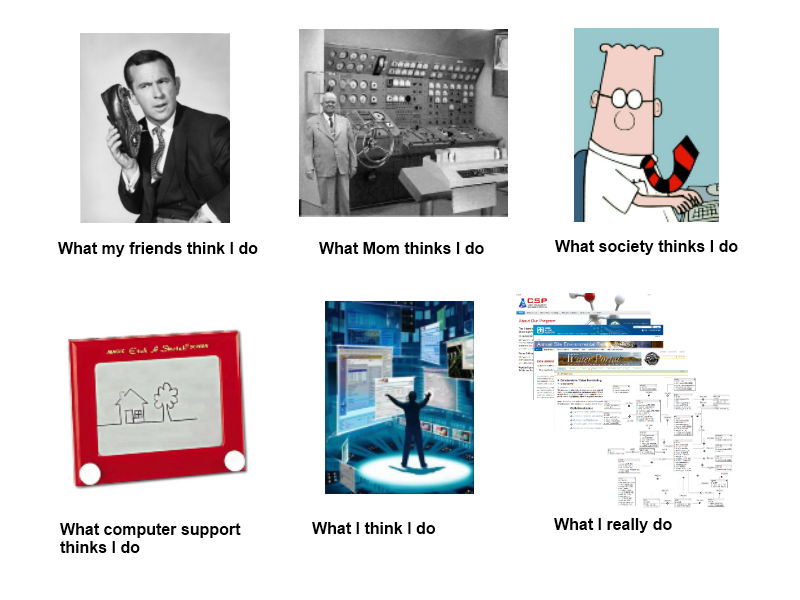
That said, I thought I'd try to capture some ideas in that latest Facebook meme, "How others see me." 

Between a fair bit of foreign travel, the geekiness of it all, and the reality on the ground, everyone around me has a different perspective.  Perhaps I'll use this for my interim performance review.

Thursday, February 16, 2012

4th Annual Great Backyard Plone Count

For the fourth year running it's time for the Great Backyard Bird Count (Plone-driven, btw) and the Great Backyard Plone Count.  While the bird count is a collaborative bird-watching effort by the Audubon Society, the Cornell Lab of Ornithology, and Bird Studies Canada, the Plone count is a voluntary effort to collect data on the world-wide distribution of Plone-powered sites.  In homage to the GBBC, the Plone count is held the same weekend, which this year is Friday 17 through Monday 20 February. 

Because many Plone sites are intranets behind firewalls, they can't be located by crawling the web.  This is a chance for developers, site owners, and users to stand up and be counted.  It's a non-scientific, totally voluntary effort for self-reporting Plone-based web portals.  Last year's results are posted at this Google Docs spreadsheet. If your input from February 2011 is still current, you're already done. 

That said, the input form on the Google Docs spreadsheet is now open.  Anyone can submit sightings of Plone in the wild.  I'll be doing some mining of Delicious and other social bookmarking services this weekend and posting them as well. 

Although there's significant bias in a survey like this, the real value comes from tracking trends over time.  This is the fourth annual Backyard Plone Count (2009, 2010, 2011) and as the number of yearly data points increase, we'll better be able to extrapolate from the observations.  It's not that we're getting an absolute count of Plone market penetrations (just like the GBBC isn't counting individual birds), it's just that we're getting a repeatable sampling by the community.  It is as more a measure of community involvement than it is a metric of the actual number of Plone sites out there. 

So get out there and spot some Plone sites -- and while you're at it, spend a little time counting birds at your feeder.

Thanks in advance!

Saturday, December 31, 2011

Plone Metrics Person of the Year

Just like every year, outstanding contributions have been made from a large number of Plonistas worldwide.  It's been a eventful year for Plone and that makes 2011's throwdown especially difficult.  Disclaimer:  Plone Metrics Person of the Year is in no way officially affiliated with Plone or its Foundation, but represents my personal effort to thank the whole community that makes the Plone ecosystem tick. 

Noteworthy contributions during 2011 that deserve a shout-out include, but are not limited to:

  • The 2011 Plone Conference people aka bunny ears (and panda hats) did a great job with this year's event.  I notice that Elizabeth Leddy, the energizer bunny of the conference, and probably some others, are missing from the Thank you page. 
  • All of those who have blogged and microblogged about Plone are another group of supporters who contribute simply by communicating your ideas, thoughts, and solutions.  Thanks to Planet Plone for pulling so many blogs together. 
  • Along those lines, Marc Corum, even thought he has stepped down from the Plone Board, is pushing to re-energize the Plone Communication and Marketing Teams.  
  • The core developers and release managers definitely need a huge shout-out for all the essential work they do. 
  • There continues to be some local Albuquerque talent in this year's nominees:  Michael Bernstein (helping out at with our Chem Security site) and Alex and Chantal at FosterMilo.
  • As always, the Foundation Board gets a great big nod of appreciation here.  Calvin Hendryx-Parker, past-Prez, gets my admiration just for wearing the shiny pants. 
This leaves me with a terrible burden--coming up with the one and only best of the best, the single Plone Metrics Person of the Year.  Casting about for some stats to back up my decidedly unscientific process leads me to the following two tables.

Table 1.  Core Developers and number of postings

Andreas Jung (ajung) 5549
Alexander Limi 2760
Espen Moe-Nilssen (espen) 1310
Martin Aspeli 1296
Jon Stahl 1257
Alex Clark (aclark) 981
Laurence Rowe 879
Graham Perrin 871
redcor 848
Mayank Patel (monks) 607
Dale DeWitt 589
George L 549
John Destefano (deesto) 486
JonStahl 464
Israel Saeta Pérez 443
Kees Hink 415
Mikko Ohtamaa 373
Eric Steele (esteele) 356
Vincent Fretin 356
Nate Aune (natea) 349

These are the top 20 people in the Core Developers forum as ranked by postings. It strongly argues for Andreas Jung to win the prize.  He's been contributing right through the holidays, not even slowing down for Festivus. If I hadn't been tipping the Aberfeldy 12-year tonight, I'd go look at the number of commits each of these have contributed in the past year, but for now, number of posts on the forum will do. 

Table 2.  Plone Foundation Board Members and Advisers with number of terms served.


Alexander Limi* 7
Toby Roberts 6
Geir Bækholt 5
Joel Burton* 5
Jon Stahl 4
Matt Hamilton 4
Steve McMahon 4
Mark Corum 3
Nate Aune* 3
Paul Everitt 3
Calvin Hendryx-Parker 2
Darci Hanning 2
Geoff Davis 2
Roberto Allende 2
Xavier Heymans 2
Alan Runyan 1
Andy McKay 1
Ben Saller 1
Bernard Bühlmann 1
Jacqueline Arasi 1
Jodok Batlogg 1
Mark Barrenechea 1
Munwar Shariff 1
Robert Boulanger 1
Sam Greenblatt 1
Sasha Vinçic 1

* Previous Plone Metrics Person of the Year

When I compiled a listing of all the past year's Board members, I was not surprised to see Alexander Limi at the top of the list.  What amazed me is that Toby Roberts is in the number two spot.  He has been the unsung hero, serving as Treasurer for every year except 2004 (when Matt Hamilton had the job). I presume he is doing the job this year, although I don't see it on the 2011-12 Foundation page.

Based on the above two tables, I'm going to toss a coin (heads: Andreas; tails: Toby).  Both have significantly contributed to Plone, both in 2011 and in the long haul.

And this year's winner of a free beer from me, is (drum roll, please)... Toby Roberts.

Just remember, Toby may be today's Plone Metrics Person of the Year, but each day every one of the members of the Plone community are winners.  And you all have my thanks.  
_______________
The author welcomes comments that commend others involved with Plone.  This brief blog post can't do justice to all the hard and creative work that's being done throughout the year. 

Wednesday, December 28, 2011

2011 Year in Review

It's very nearly the end of the year, which is probably why I'm listening to "Driving the Last Spike" by Genesis off their I Can't Dance album. So here's a wrap-up of Plone Metrics for 2011.

I'm always surprised when I go back and look at my posts, realizing what was a newsworthy item at the time.  But if you reflect on last year, you'll recall that in January the Arab Spring was upon us.  Plone.org users among thousands of others from Egypt were blocked when Mubarak shut down the country's Internet.  Continued unrest in the region has meant that many have had to turn to services like TeleComix to access the Web.

Besides the political, there were natural disasters, foremost of which was the Japanese earthquake and tsunami.  The impact of that event was readily visible in the stats from Google Analytics when I compared March 2010 with 2009.  Below, the red arrow indicates the Fukushima Prefecture, which to this day is hard hit by the continuing radiological drama.
In between those two events, the Cioppino Sprint took place.  One notable result was the migration of Plone.net over to Plone.org.  The result, as one might expect, was the complete loss of traffic (and a boost over at Plone.org).  As you can see, the drop-off was nearly instantaneous.
Amazon sales rank statistics were continued to be tracked for Plone books, although my quarterly schedule broke down.  Life happens.  In February the annual Great Backyard Plone Count was carried out. 

In July Plone Metrics chopped through CMS Matrix in an effort to see how things stood with Plone's standing in that venue.  Even admitting the flaws in a self-reporting and hence biased compendium like CMS Matrix, the results for Plone were very positive.  Plone scored 97% of all features listed.

In September an inquiry raised in a LinkedIn forum led to a summary that in many ways captures Plone's strengths.  It's always gratifying to be able to respond to someone's questions with point-by-point material that addresses matters concretely.

November saw the San Francisco Plone Conference, a tremendously successful event.  There was tweeting in abundance but no live blogging from me.  Following up on that, Plone Metrics took a lighthearted look at the Plone Conference attendance numbers earlier this month.  That in turn led to Lennart Regebro's insightful analysis.

The only thing left is the annual New Year's Eve posting of the Plone Metric's Person of the Year.  This is the fifth year for this annual shout-out to the community.  Now accepting nominations--please feel free to comment with your suggestions on who is the best of the best.

Saturday, December 3, 2011

Plone Conference 2011 by the Numbers

And an exercise in "scientifically" locating the 2012 conference. 

The numbers are in and San Francisco looks like this against the last five Plone Conferences. 

Location Attendance
2011
San Francisco
265
2010
Bristol
285
2009
Budapest
420
2008
Washington
350
2007
Naples
415
2006
Seattle
258

With Naples and Budapest looking so good, one is tempted to say that Europe is the more successful venue.  I ran a Student's t-test in order to see if the two sample populations, Europe and North America, were significantly different.  The null hypothesis is that there is no difference between the European and North American conference attendance numbers. 

For the data above with a standard deviation of 65.1 and 4 degrees of freedom for the test, the t value was -1.55.  The probability of this result, assuming the null hypothesis, is 0.196.  This does not meet the usual 0.05 value for significance.  We accept the null hypothesis that Europe and North America are the same.  

World Plone 2012

The call for proposals for the 2012 Conference is out.  Let's see what sort of trouble we can get in with the above table. 

First, turn the cities into latitude and longitude coordinates, then calculate the average of all six venue locations weighted by attendance.  The result looks like this:

The red 'X' indicates the location of the weighted average, the spot that maximizes attendance while minimizing travel costs.  It's the perfect location for next year's conference. 

There's only one problem... the actual location is in the middle of the North Atlantic:


The nearest land is either St. John's, Newfoundland or the Madeira Islands.  St. John's has an October-November average high temperature of 6-11 C (43-51 F) and the remarkable beverage, Newfoundland Screech.  Apparently, some of the best food in Canada is to be found there, plus I like snowshoeing. 

Madiera, on the other hand, has an average Oct-Nov high temperature of 20-23 C (68-73 F) and a famous wine named after the island.  One of the conference centers in Funchal looks suitable.


I urge the Plonistas in Newfoundland and Labrador along with those in Madiera to submit proposals.